Photini Family — Higher-Level Principles for Ethics & Compliance
Version 1.2 · Last updated: November 2026 · © 2025–2026 Photini Family™ · Public
This is a living document. Its change-log structure is defined in Section 10, and its full version history is kept in the project repository.
1. Preface
The Photini Family — comprising Photini™ (advocacy and technology), Rhea Network™ (research and healing technology), and Nektarios™ (human-process governance) — is an ecosystem dedicated to AI-powered advocacy, child protection, legal aid, ethical AI governance, trauma-informed support, and survivor-led innovation.
Nektarios™ is Photini Family's internal Human Governance Kernel. It is designed to govern role-based access rules, case-level ethics checks, document integrity, compliance process workflows, and multi-jurisdictional logic routing. Nektarios is being built into the Management Dashboard of the Go-Driver platform and will extend to all Photini Family applications and ecosystems (Photini Beacon, Photini Phoní, Photini Bridge, Rhea Network, Rhea Wisdom, Rhea Shield, Rhea Beacon).
Our work serves the most vulnerable: children and families affected by discrimination, legal fragmentation, violence, or institutional failure, with a core emphasis on immigrant-background and cross-cultural families.
Our founding principle comes from lived experience and system-level research:
"Quality, trust, and data integrity with AI hand-in-hand with humans; misinformation is more dangerous than responsible data sharing."
This document establishes the ethical spine for all Photini Family systems — legal, organizational, technological, therapeutic, creative, and collaborative. It is a living document: internally binding, publicly transparent, and shaped continuously by new legislation, AI safety research, trauma science, community insight, system audits, and human-rights reporting.
2. Supreme Principles (Maslow-Aligned and Human-Rights-Based)
These Supreme Principles define the first layer of governance across Photini Family. Every decision, workflow, dataset, user experience, and algorithm must trace back to these values.
Local vs International Hierarchy
A clear principle for conflicts of norms:
Hierarchy Principle: "In all cases of conflicting standards or laws, Photini Family defaults to the highest available standard of child protection — whether the UN Convention on the Rights of the Child (UN CRC), other international human-rights conventions, or constitutional and national child-welfare law. When in doubt, the child's best interests and intrinsic rights, as recognised in global human-rights treaties, and the child's principal psychological needs (Maslow) are decisive."
Highest Standard Clause: "Whenever Photini Family applies legal or ethical norms, international conventions and constitutional rights are interpreted as primary rights — overriding lower or conflicting provisions. Local requirements serve as a baseline, not a ceiling."
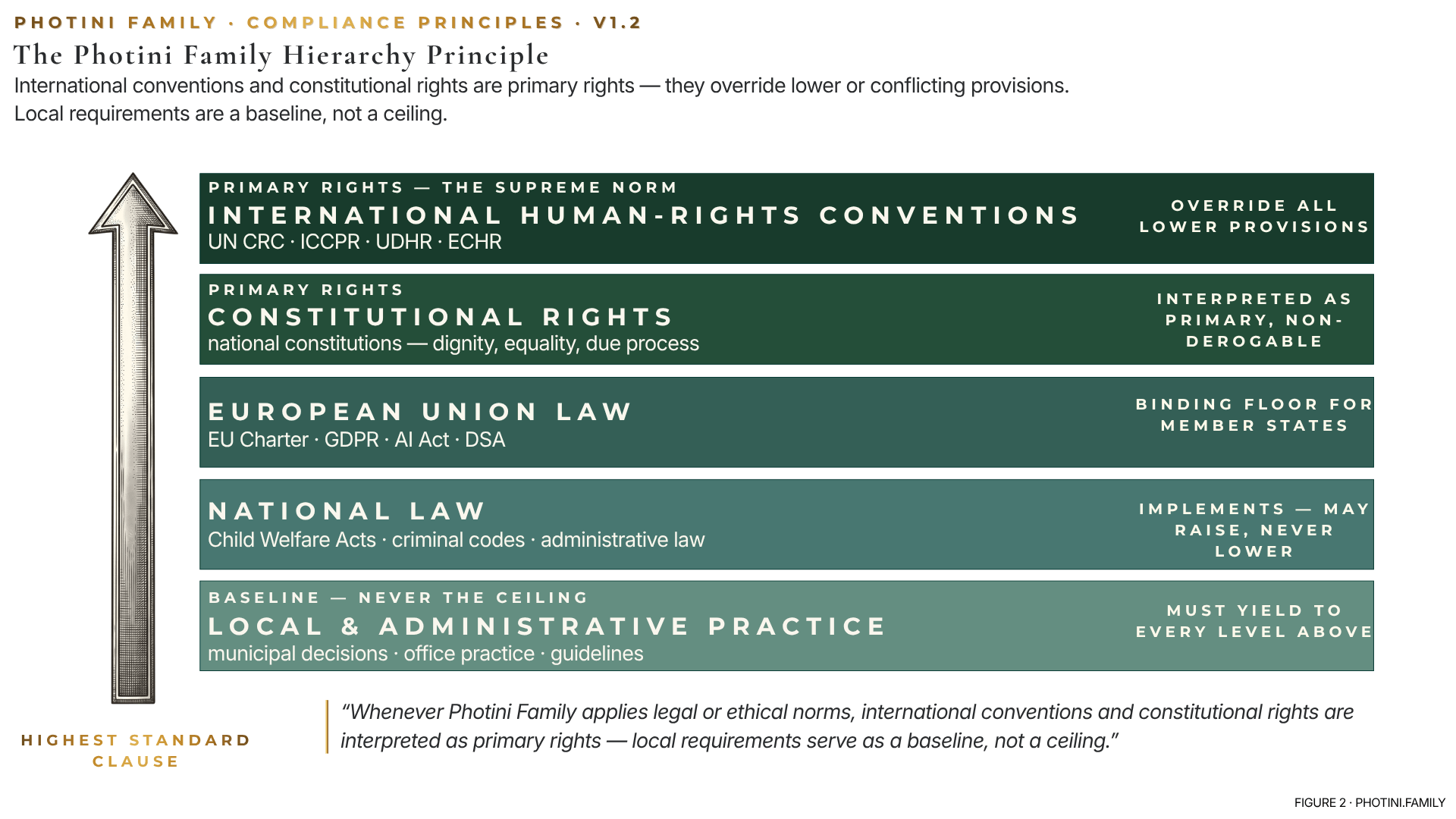
Primary and Fundamental Rights as Supreme Norms — Legal and Psychological Foundations
The Photini Family governance model draws on two interlocking pillars: international legal doctrine (primary rights and supreme norms) and Maslow's hierarchy of principal psychological needs. Together they define the highest and most non-negotiable standards for all actions, designs, policies, and technologies within the ecosystem.
Pillar 1 — The Legal Principle and Its Origin
The concept of "primary" or "fundamental" rights as paramount is rooted in the core international legal instruments.
UN Charter, Article 55(c) — the multilateral commitment [UN-Charter-1]
What it says: The United Nations "shall promote… universal respect for, and observance of, human rights and fundamental freedoms for all without distinction as to race, sex, language, or religion."
What it means: Article 55(c) is part of the UN Charter, a binding treaty for all UN Member States. It does not list specific rights; it creates a general obligation, and together with Article 56 it commits the UN and its Member States to act jointly and separately to achieve universal respect for human rights. It frames human rights as integral to peace, stability, and friendly relations — not as optional policy add-ons.
Key principle: Human rights and fundamental freedoms are universal, non-discriminatory, and form a baseline obligation for states and institutions.
Universal Declaration of Human Rights (UDHR, 1948) — the catalogue of rights [UDHR-1]
What it says: The UDHR proclaims "a common standard of achievement for all peoples and all nations" and enumerates the basic rights and fundamental freedoms every human being holds by virtue of being human — civil, political, economic, social, and cultural.
What it means: The UDHR is a General Assembly declaration, formally non-binding, drafted to give content to the Charter's open-ended references to "human rights and fundamental freedoms" (Charter Articles 1(3), 55 and 56). It has become the normative backbone of international human-rights law, is widely treated as evidence of customary international law, and has inspired all the core human-rights treaties. Its non-discrimination formula is broader than the Charter's: "race, colour, sex, language, religion, political or other opinion, national or social origin, property, birth or other status."
Key principle: Universality, indivisibility, and equality of all basic rights — no hierarchy that allows some rights to be denied in the name of others, and no discrimination on any status.
International Covenant on Civil and Political Rights (ICCPR, 1966) — rights made binding [ICCPR-1]
What it says: The ICCPR reaffirms that civil and political rights "derive from the inherent dignity of the human person" and binds ratifying states to respect, protect, and fulfil them.
What it means: The ICCPR transforms the UDHR's civil and political rights into treaty-level obligations with monitoring and accountability — giving operational force to the principle that certain rights (life, liberty, fair trial, expression, privacy, family life, protection from torture) are non-negotiable.
Key principle: Inherent dignity as the source of rights, with a strong non-derogable core (prohibition of torture, slavery, and arbitrary deprivation of life) that no emergency, policy, or convenience can override.
UN Convention on the Rights of the Child (UN CRC), Articles 4 and 41 — the child-specific floor and the higher-standard rule [UN-1][UN-2]
What it says: Article 4 requires states to take "all appropriate legislative, administrative and other measures" to implement the rights recognized in the Convention, using the maximum available resources. Article 41 adds the higher-standard rule: if national law or another applicable international law is "more conducive to the realization of the rights of the child" than the Convention, the more protective standard prevails.
What it means: The UN CRC reframes general human rights as specific, concrete obligations owed to children. Article 41 encodes a systemic "best standard wins" logic: the Convention operates as a minimum floor, not a ceiling, and whichever rule best protects the child must be applied.
Key principle: Primacy of the child's rights and interests, with a dynamic comparison of norms so that more protective standards override less protective ones.
Constitutional and Fundamental-Rights Practice
In many constitutional systems — including the European Union's fundamental-rights doctrine and national bills of rights — human rights and child-specific rights, inspired by these core international instruments, are designated as "primary" or "supreme" rights. They occupy the highest position in the legal hierarchy, override lesser or conflicting laws, rules, and policies, and function as a control standard for all subsequent law, policy, and organizational practice. They are often directly applicable, justiciable, and binding on both public authorities and private actors in key sectors (digital services, welfare, education, justice), especially where vulnerable groups such as children are concerned.
For Photini Family, this constitutional logic is mirrored internally: fundamental human and child rights are treated as primary internal norms that override all internal rules, product decisions, and workflows.
Pillar 2 — Maslow's Hierarchy: Principal Psychological Needs
What it is: Maslow's theory identifies a core set of psychological needs essential to all human flourishing — especially for children:
- Physiological needs — bodily needs of health, nutrition, warmth, care, water and adequate shelter
- Safety and recovery needs — freedom from fears, physical and emotional security, predictability, protection from violence, and support to recover — including the longing for nature: restorative contact with natural elements (water, cold, fresh air, warmth, forest) that helps an over-alarmed nervous system heal from long-term traumatic stress
- Love and belonging — close relationships, attachment, identity, family relations, and appropriate care
- Esteem and agency — developing self-esteem, dignity, and respect: the child's own voice, a view that receives genuine consideration, and the agency to act on it
- Cognitive development — sociability, the need for connection, learning and understanding, information and expression
- Aesthetic needs — the desire for a pleasant home and environment, beauty and surroundings, culture and play
- Self-actualization — creativity, art and the appreciation of beauty, a sense of self-worth, personal fulfilment, developing one's talents and creative potential
- Self-transcendence — the development of a worldview: meaning and contribution through conscience and purpose, and the thirst for knowledge that reaches beyond oneself
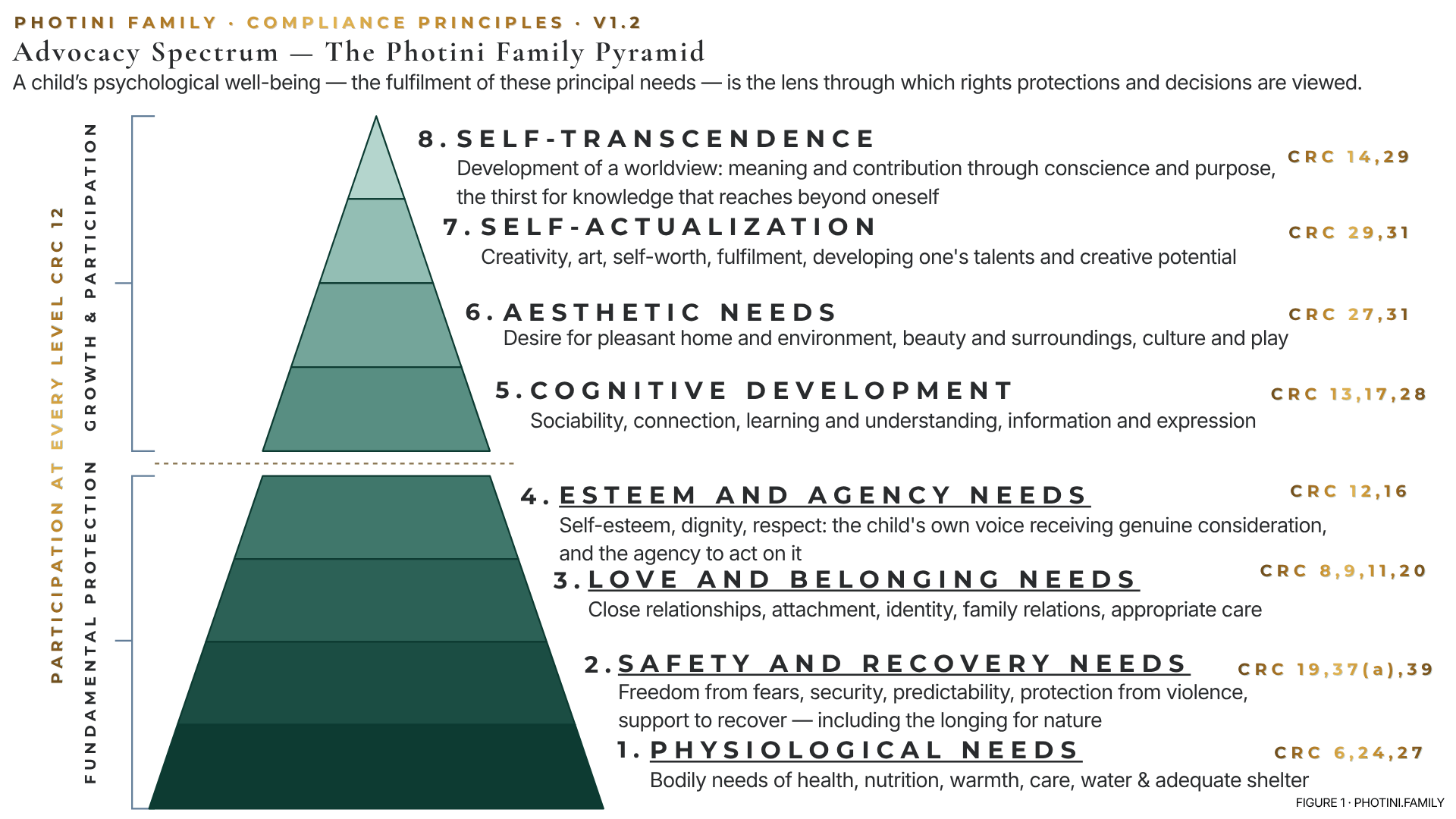
Why it matters: These needs provide a universal, developmental blueprint for human and child well-being, reinforcing the content and prioritization of legal rights. Human-rights violations always target a person's principal psychological needs — and above all the fundamental needs.
Key principle: A child's psychological well-being — defined by the fulfilment of these principal needs, with the fundamental needs always primary — must be the lens through which rights protections and organizational decisions are viewed.
Constitutional Justice as Externalised Cognitive Architecture
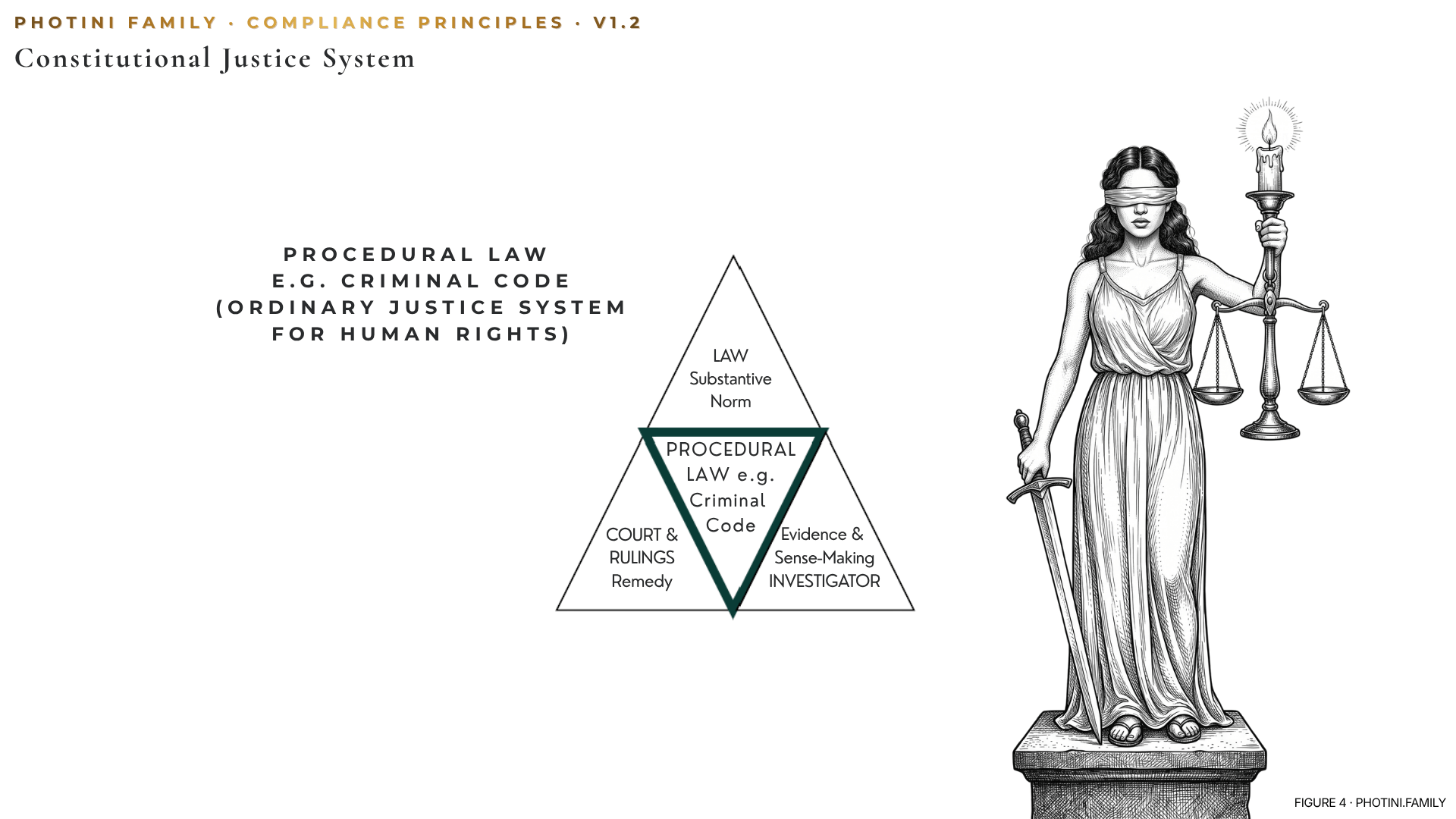
The constitutional triangle — Substantive Law, Investigative Inquiry, and Judicial Remedy — mirrors human psychological resolution: Reason, Integrated Mind, and Emotional Reaction. In cognitive psychology, stable decision-making requires integrating objective perception (Reason), conclusive sense-making (Mind), and affective evaluation (Emotion). Constitutional justice is the same architecture at societal scale: substantive law supplies the shared perception of what is right, investigative inquiry performs the society's sense-making, and judicial remedy carries the evaluative, corrective response.
Public accountability therefore cannot operate as an abstract administrative checklist. Constitutional justice is fundamentally an architecture created by humans, for humans — and when any node of the triangle fails, the failure is not merely procedural but cognitive: the system loses its ability to perceive, to make sense, or to respond.
Photini Tech solutions are designed around this insight. The governed pipeline — translate, document, act, unlock data, research, remedies — exists to repair each node of the constitutional triangle where it has broken, and to keep the human and the institutional architectures aligned.
The Integrated Principle — Legal-Psychological Integration
The supreme norm is the unbreakable linkage between a child's intrinsic legal rights, as protected under international and constitutional law, and their principal psychological needs, as articulated by Maslow.
Every decision, workflow, dataset, user experience, and algorithm within Photini Family must be justifiable not only in legal terms (compliance with the highest applicable rights standard) but also in psychological terms (furthering the child's core developmental and emotional needs).
Conflict of norms: In any case of doubt, ambiguity, or legal or ethical conflict, the decisive standards are:
- the best interests of the child (UN CRC and related international instruments);
- the highest available legal standard for child protection; and
- the child's principal psychological needs — the fundamental needs (physiological, safety and recovery, love and belonging, esteem and agency) and the growth and development needs (cognitive development, aesthetic needs, self-actualization, self-transcendence).
Maslow Alignment Clause: "All processes, technologies, and decisions must actively promote — or at minimum safeguard — the child's principal psychological needs. No organizational or operational interest may take precedence over these core human needs."
Aligned with Maslow's hierarchy of human needs and international human-rights law, these core principles establish the ethical spine of the Photini Family ecosystem.
2.1 Human Dignity and Autonomy
Foundation: "Every human being has inherent worth, identity, and the right to self-determination — especially children, who possess inherent worth and control over decisions affecting their lives."
Implementation requirements:
- Human choice is always available and meaningful in all AI workflows.
- Trauma-informed design ensures psychological safety; consent is developmentally appropriate, trauma-sensitive, and reversible.
- User-autonomy controls are always available: "Why am I seeing this?", "Stop", "Undo", "Delete data".
- Consent flows reflect cognitive and developmental reality, not assumptions.
- All explanations are clear, inclusive, and accessible across literacy levels.
- All high-risk or child-related actions require human oversight and mandatory escalation.
- No automated decision may override a user's bodily, emotional, legal, or psychological rights, nor influence decisions about family unity, legal status, safety, medical implications, or cultural and language identity.
Legal anchors
Universal Declaration of Human Rights, Article 1 — Inherent dignity [UDHR-2]
Text: "All human beings are born free and equal in dignity and rights. They are endowed with reason and conscience and should act towards one another in a spirit of brotherhood."
What it means: Dignity and rights are inalienable for all humans; they exist by virtue of being human, not by grant of any state. Dignity is the moral foundation that underpins every other right in the Declaration, and Article 1 sets the tone for all that follows: civil, political, economic, social, and cultural rights all rest on the assumption of shared dignity and equality. The article also calls for solidarity — compassionate, empathetic relations, mutual respect, and cooperation among all people. Article 1 requires not just equal treatment but respect and solidarity, forming the cornerstone of the modern human-rights system.
How Photini Family applies it: Dignity is embedded at all levels — every technology process, partnership, and advocacy campaign is built on the conviction that dignity is intrinsic to every person, child or adult. Barriers that undermine dignity and equality are actively removed, and outreach and operations consciously include and empower marginalised or underserved groups. Decision-making and care models ensure that children, families, and community advocates are heard, respected, and protected in every process, and creative and digital tools are used to advance human dignity in all settings. No system, algorithm, or partnership may ever reduce a person to a data point or treat them as lesser.
"Every Photini Family process, safeguard, and tool recognizes and enacts the principle that dignity is inherent and inalienable for every individual — never conditional or negotiable."
International Covenant on Civil and Political Rights, Article 16 — Recognition before the law [ICCPR-2]
Text: "Everyone shall have the right to recognition everywhere as a person before the law."
What it means: Every individual has the fundamental right to be recognized as a person with legal capacity and rights. States and institutions cannot deny anyone their legal identity, status, or standing. Legal recognition is the prerequisite for accessing all other rights, remedies, and protections — the foundation for justice.
How Photini Family applies it: Every child, family member, and user — regardless of background, status, or circumstances — is recognized, respected, and protected as a full legal person in all Photini Family systems and workflows. No digital, legal, or organizational process may undermine, question, or arbitrarily anonymise a person's legal status. All products, policies, and advocacy initiatives are designed to eliminate any risk of "invisible" or excluded persons, so that personhood is a starting point — never a barrier — for justice, privacy, and dignity.
"All users — especially trauma-affected children and families — are guaranteed recognition, participation, and privacy in both analogue and digital environments. No system denies personhood, access, or respect before the law."
International Covenant on Civil and Political Rights, Article 17 — Privacy and dignity [ICCPR-3]
Text: "1. No one shall be subjected to arbitrary or unlawful interference with his privacy, family, home or correspondence, nor to unlawful attacks on his honour and reputation. 2. Everyone has the right to the protection of the law against such interference or attacks."
What it means: The article safeguards personal life, family, home, and communications from arbitrary or unlawful interference; protects individuals from unlawful attacks on dignity and social standing; and obliges states to provide legal protection and remedies against violations.
How Photini Family applies it: Privacy is treated as a right, not a feature: every design, advocacy, and technical process protects personal and family data from arbitrary, excessive, or unlawful interference. All systems minimise data collection, fortify consent flows, and embed strong review protocols for privacy-sensitive decisions. No user — especially children or trauma-affected families — may be exposed to risk from data leaks, reputational harm, or discriminatory surveillance. Cases of privacy violation, misuse, or unauthorised data handling are immediately escalated, investigated, and remedied, with transparent outcomes and external accountability. Privacy is also a creative basis for user dignity, agency, and secure self-expression in every Photini Family offering — not merely a negative protection.
"No child, parent, or user is subject to unlawful or arbitrary interference with privacy or family; Photini Family employs data minimization, robust safeguards, and direct remedy protocols for all privacy concerns."
UN Convention on the Rights of the Child, Article 3 — Best interests of the child [UN-3]
Text: "1. In all actions concerning children, whether undertaken by public or private social welfare institutions, courts of law, administrative authorities or legislative bodies, the best interests of the child shall be a primary consideration. 2. States Parties undertake to ensure the child such protection and care as is necessary for his or her well-being, taking into account the rights and duties of his or her parents, legal guardians, or other individuals legally responsible for him or her, and, to this end, shall take all appropriate legislative and administrative measures. 3. States Parties shall ensure that the institutions, services and facilities responsible for the care or protection of children shall conform with the standards established by competent authorities, particularly in the areas of safety, health, in the number and suitability of their staff, as well as competent supervision."
What it means: The best interests of the child must be a primary consideration in all decisions affecting them — in individual cases and equally in policy, law, and administrative procedures. States must ensure the protection and care necessary for the child's well-being and uphold quality standards for all child-related institutions, facilities, and services. Determining best interests requires weighing the child's physical, emotional, and educational needs, family circumstances, cultural identity, and long-term impacts. Article 3 is one of the four general principles of the UN CRC — alongside non-discrimination, survival and development, and respect for the views of the child — guiding the interpretation of all other articles. In practice, adults and authorities must actively demonstrate that the child's best interests have been seriously considered and made central, even when balanced against other rights or needs.
How Photini Family applies it: Every workflow, product, and partnership puts the child's holistic best interests first; decisions are documented, transparent, and child-centred — never subordinated to institutional convenience or profit. Safeguards, services, and digital tools prioritize the child's welfare in every decision, partnership, and creative project, integrating each child's physical, emotional, cultural, and long-term needs — never reducing children to data points. All organizational actions require explicit documentation showing how the best-interests standard was considered, achieved, and improved, and systems are audited to verify that "best interests" is operationalised, not rhetorical. Photini Family champions reform wherever state practices, sector norms, or institutional standards fall short of genuinely protecting and empowering children. Through constant innovation, feedback loops, and development indicators, measures, and controls, Photini Family works to ensure the best possible interpretation and performance in the best interests of the child — developing ways for children of every age, ethnicity, religion, and background to improve their physiological needs (health, nutrition, shelter), safety and recovery needs (physical and emotional security, predictability), love and belonging (attachment, acceptance, family, friendships), esteem and agency (dignity, respect, recognition), cognitive development, aesthetic needs, self-actualization, and self-transcendence.
"The best interest of the child drives every decision and escalation, from design to everyday response, with transparent documentation and review. The best interests of every child are inseparable from their inherent dignity and right to self-determination. Every decision, interface, and partnership must honor the child as a unique person whose welfare, will, and holistic needs drive all outcomes — not as a passive object of concern, but as a subject with rights, agency, and voice."
UN Convention on the Rights of the Child, Article 12 — The child's voice [UN-4]
Text: "States Parties shall assure to the child who is capable of forming his or her own views the right to express those views freely in all matters affecting the child, the views of the child being given due weight in accordance with the age and maturity of the child."
What it means: Children have the right to express their views freely on all matters affecting them; those views must be seriously considered and documented in decisions; respect for developmental stage ensures appropriate engagement; and participation is not optional — it is a fundamental right.
How Photini Family applies it: The right to a voice is inseparable from dignity and self-determination: every child is an agent, not an object, in all Photini Family systems, advocacy, and digital interactions. Children's views are not only solicited but given due weight and documented in all decisions, processes, and outcomes, with age and maturity respected. Children are empowered to ask, contest, and change decisions — every workflow and explanation must invite and respect the child's perspective and challenge. Children are co-creators, not just recipients: every product and service incorporates child feedback and provides channels for children to contribute ideas, criticisms, and lived experience. All platforms and engagement channels are accessible by age, ability, and language, so that every child can meaningfully influence outcomes rather than speak "into the void" — with multilingual, trauma-sensitive, and accessible communication tools that remove barriers of disability, language, or background. Children's views receive practical impact and genuine consideration, with feedback documented and visible in all major decisions and case processes, and Photini Family systems cultivate children's confidence and skills to advocate for themselves, design consent, and co-author their digital and real-world experiences. Photini Family goes beyond compliance — embedding child participation in governance, research, casework, system improvement, and creative development, so that children help lead progress in their own protection, welfare, and digital experience.
"Every child has the right to influence, challenge, and shape all matters affecting them — built into both interface interaction and strategic policy."
EU Charter of Fundamental Rights, Article 1 — Human dignity [EU-Charter-1]
Text: "Human dignity is inviolable. It must be respected and protected."
What it means: Human dignity is recognized as an absolute, foundational value in EU law; it cannot be restricted or derogated under any circumstances. Article 1 is the starting point of the Charter — many other rights and freedoms derive from and build upon the respect and protection of human dignity. It binds all EU institutions, bodies, and Member States when implementing EU law, and it applies to all people equally, recognizing the inherent worth of every individual irrespective of status, circumstance, or background.
How Photini Family applies it: Dignity is the non-negotiable foundation. No feature, algorithm, or policy may degrade, humiliate, or exploit users. All systems undergo dignity screenings; violations trigger immediate escalation, remediation, and public accountability. Dignity informs every decision — from interface design to crisis intervention.
European Convention on Human Rights (ECHR), Article 8 — Private and family life [ECHR-1]
Text: "Everyone has the right to respect for his private and family life, his home and his correspondence. There shall be no interference by a public authority with the exercise of this right except such as is in accordance with the law and is necessary in a democratic society in the interests of national security, public safety or the economic well-being of the country, for the prevention of disorder or crime, for the protection of health or morals, or for the protection of the rights and freedoms of others."
What it means: Article 8 protects private life (personal identity, autonomy, dignity, physical and psychological integrity, relationships, and personal information), family life (the unity and relationships of parents and children — including biological, adopted, and foster relationships — spouses, partners, and others with genuine dependency or substantial shared life), the home, and all forms of correspondence, digital or analogue. It establishes both negative obligations (states must not arbitrarily interfere) and positive obligations (states must actively protect and facilitate private and family life — for example, maintaining family unity and supporting contact after separation). It is a qualified right: interference is lawful only if it is in accordance with the law, necessary, and proportionate to a legitimate aim. The strength of protection varies with the reality of family ties, not merely formal or legal status. This is directly relevant to Photini's trauma-informed design and family-reunification mission.
How Photini Family applies it: Photini Family defends and strengthens family unity, privacy, and secure communication. All tools are designed to prevent wrongful separation, support reunification, and empower families facing systemic exclusion or institutional interference. Privacy protections extend to emotional, cultural, and relational dimensions — never only technical compliance.
Why this matters for advocacy and AI technology
These foundational rights — dignity, autonomy, privacy, legal recognition, best interests, and child voice — are not abstract ideals for Photini Family. They are operational standards, embedded in every algorithm, workflow, partnership, and user interaction. Technology is built to serve, empower, and protect — never to surveil, exploit, or exclude. Compliance is just the starting point; the goal is lived, measurable dignity and justice for every child and family.
2.2 Transparency and Explainability
Foundation: "People have the right to understand how technology impacts their rights, safety, cases, or lives. All users deserve to understand how AI affects rights and outcomes."
Implementation requirements:
- Plain-language explanations accompany all AI decisions and outputs. AI explainability is not optional: for at-risk children and families, understanding why helps target support, avoid errors, and meaningfully contest decisions. Users can always ask: "Why am I seeing this?"
- Decision summaries must include reasoning, sources, and limitations.
- All transparency must be accessible across languages and cognitive loads.
- Photini's policies, standards, versioning, and audit logs are published openly.
- Information and documentation: plain-language explanations, audit logs, version history.
- Reporting and oversight: annual reports, disclosure of incidents, open standards.
- Participation: user education, feedback and appeal mechanisms, multilingual access.
- Routine equity audits and open public feedback mechanisms ensure continuing alignment and surface new or subtle barriers as technologies and user communities evolve.
- A Transparency Report is published regularly, covering AI updates, detected biases, safety incidents, and data-usage summaries. Transparency reports do not just track compliance — they give families and advocates the actionable, accessible data needed to spot discrimination, intervene, and drive reform.
Transparency as a non-discrimination safeguard (ECHR Article 14 in the Nordic context)
ECHR Article 14 prohibits discrimination in the enjoyment of Convention rights on grounds including "sex, race, colour, language, religion, political or other opinion, national or social origin, association with a national minority, property, birth or other status." While Article 14 does not create an independent right to transparency, it prohibits discrimination in the enjoyment of other Convention rights, including Article 6 (fair trial), Article 8 (family life), Article 3 (protection from degrading treatment), and Article 13 (effective remedy).
In the Nordic context — particularly the Finnish child-protection system — lack of transparency is not a neutral administrative failure. It functions as a discriminatory barrier affecting immigrant and otherwise vulnerable families and children, bilingual and multicultural parents, children and parents who cannot access or correct information held about them, parents who do not speak Finnish, and families facing structural bias or unequal treatment.
When authorities control all information flows; act simultaneously as investigator, decision-maker, data gatekeeper, and evidence provider; withhold information from families, lawyers, courts, doctors, family-rehabilitation facilities, family workers and other professionals working with the child, evaluation boards, daycares, and schools; deny access to case files or deny corrections and input into them; use secrecy or selective disclosure; and thereby prevent research, data sharing, monitoring, and measurement — this directly interferes with ECHR Article 8 (family life), Article 6 (fair trial and due process), Article 3 (protection from degrading treatment), and Article 13 (effective remedy). In systems where authorities serve simultaneously as information controller, investigator, decision-maker, and evidence gatekeeper, selective disclosure or withholding of information seriously harms children's primary rights.
Legal interpretation: Because the discriminatory obstruction of transparency violates the enjoyment of other Convention rights, ECHR Article 14 applies in combination with Articles 6 and 8, establishing a right to non-discriminatory access to information, evidence, and procedural fairness. Transparency and explainability are therefore not merely administrative duties — they are non-discrimination safeguards.
This is why Photini Family anchors its transparency obligations under UN CRC Article 2 (non-discrimination), EU Charter Articles 20–21 (equality and anti-discrimination), GDPR Articles 12–14 (accessible information), EU AI Act Articles 5 and 13 (prohibited practices; transparency), and ECHR Article 14 applied together with Articles 6 and 8 in child-protection contexts. This framing is legally accurate, UN-compatible, and aligned with international jurisprudence on discriminatory denial of information and on the misuse or falsification of information against children's primary rights.
Legal anchors
UN Convention on the Rights of the Child, Article 2 — Non-discrimination [UN-5]
Text: "States Parties shall respect and ensure the rights set forth in the present Convention to each child within their jurisdiction without discrimination of any kind, irrespective of the child's or their parent's or legal guardian's race, colour, sex, language, religion, political or other opinion, national, ethnic or social origin, property, disability, birth or other status."
What it means: Article 2 is a categorical obligation: discrimination in protection, access to information, or participation is strictly prohibited. In the context of transparency, every explanation, report, and feedback mechanism must be accessible, comprehensible, and safe — regardless of language or background.
How Photini Family applies it: All child-protection, support, and digital services are designed and delivered without any form of discrimination, with full and equal access for every child and family. Every product, outreach effort, and communication is reviewed for both direct and indirect discrimination — addressing subtle, systemic, and structural barriers, not only obvious ones. Regular equality audits identify, prevent, and remove obstacles facing marginalised children, including those related to disability, language, background, or immigration status, and Photini Family advocates for policies and tools that actively break cycles of exclusion and prejudice.
"All transparency and information tools are designed and tested to guarantee non-discriminatory access, regardless of language, disability, or background, in line with the universal child-rights guarantee of Article 2. No policy or process ever excludes on grounds of race, origin, status, or circumstance; equality and inclusion are designed in from the start."
EU Charter of Fundamental Rights, Articles 20–21 — Equality before the law; Non-discrimination [EU-Charter-2][EU-Charter-3]
Text (Art. 20): "Everyone is equal before the law." Text (Art. 21): "Any discrimination based on any ground such as sex, race, colour, ethnic or social origin, genetic features, language, religion or belief, political or any other opinion, membership of a national minority, property, birth, disability, age or sexual orientation shall be prohibited."
What it means: Article 20 requires that all persons be regarded as equal in legal rights and access, with no arbitrary distinction. Article 21 prohibits discrimination on an extensive list of grounds. Together they guarantee not only equal rights but active anti-discrimination duties for institutions and technology developers.
How Photini Family applies it: Every child and family is guaranteed equal treatment and service at all decision points, interactions, and content across Photini's systems, regardless of status or background. Any form of bias, exclusion, or disadvantage — algorithmic, administrative, or interpersonal — is actively prevented, monitored, and corrected. All information, rights, and feedback mechanisms are easily accessible to diverse users, with special provisions for speakers of different languages, people with disabilities, and minorities. Advocacy, design, and partnerships are built with intersectionality in mind: anti-discrimination is an ongoing commitment, addressed in policy, training, digital workflows, and public documentation — proactively searching for and removing barriers to transparency for all users, never only those who already enjoy majority privilege.
"Every Photini Family communication, platform, and reporting protocol is structured to ensure full equality before the law and active anti-discrimination, explicitly reflecting the requirements of Articles 20 and 21 of the EU Charter. Photini Family systematically identifies and erases structural, digital, or linguistic bias, guaranteeing every user the same legal, informational, and advocacy protections."
General Data Protection Regulation (GDPR), Articles 12–14 — Transparency, information, and communication [GDPR-1][GDPR-2][GDPR-3]
In brief: Controllers must provide clear, concise, intelligible, and easily accessible information about data collection, purposes, retention, rights, and legal bases — both when collecting data directly (Art. 13) and when obtaining it from other sources (Art. 14). Article 12 requires plain language, especially when addressing children; requires controllers to facilitate data-subject rights (access, rectification, erasure, restriction, objection, portability); sets a one-month response timeframe; and requires refusals to be explained with information about the right to complain. Articles 13 and 14 specify the required content of notices, including recipients, retention periods, the existence of automated decision-making and profiling with its logic, significance, and consequences, and — for indirectly obtained data — the source.
How Photini Family applies it: Every point of user interaction includes upfront, easy-to-understand notification about what data is collected, its lawful uses, and the subject's rights. Explanations and notices are tailored for children, families, and vulnerable groups, using visuals, plain language, and multilingual options. All individuals — regardless of disability, nationality, or age — can exercise their rights of access, rectification, erasure, and objection with respectful, prompt support. Consent is iterative: choices are collected, revisited, and honoured, and it is easy to modify consent and understand the consequences over time.
"Our users receive clear, prompt information at every data collection point, and can easily access, correct, or delete their information — honouring both the letter and spirit of EU/EEA data protection law."
EU AI Act, Article 5 — Prohibited AI practices [AI-1]
In brief: Article 5 establishes a categorical ban on AI practices presenting unacceptable risk to fundamental rights, public safety, and EU values: subliminal, manipulative, or deceptive techniques that materially distort behaviour and cause significant harm; exploiting the vulnerabilities of specific groups (children, people with disabilities, socioeconomically disadvantaged groups); social scoring; predictions of criminality based solely on profiling or personal traits; untargeted scraping of faces from the internet or CCTV to build biometric databases; emotion recognition in employment or educational settings (with narrow medical and safety exceptions); and real-time remote biometric identification, with strictly limited law-enforcement exceptions. Violations can bring fines of up to the higher of €35 million or 7% of global annual turnover.
How Photini Family applies it: No Photini technology or advocacy solution will ever employ manipulation, vulnerability exploitation, unjust profiling, or social scoring; such conduct is categorically banned across all platforms and partnerships. All digital products are proactively screened and audited for traces of prohibited practices, with clear escalation and correction protocols, and partners, staff, and users are encouraged, empowered, and protected when reporting risks. AI deployments always include child- and family-friendly opt-outs and information about automated functions, so that all interactions remain understandable and free from undue influence.
"Photini Family categorically bans harmful or manipulative AI uses — a rule enforced not only through technical design but through regular team audits and open user feedback, so that no prohibited practice can be hidden or ignored."
EU AI Act, Article 13 — Transparency for high-risk systems [AI-2]
Text: "High-risk AI systems shall be designed and developed in such a way that their operation is sufficiently transparent to enable deployers to interpret the system's output and use it appropriately."
What it means: Providers of high-risk systems must supply clearly documented instructions covering provider identity and contact details; intended purpose, limitations, and capabilities; expected accuracy, robustness, and cybersecurity; known and foreseeable risks, including from misuse; explanation of outputs and human-oversight measures (see Art. 14); technical requirements, expected system lifetime, and maintenance; and logging mechanisms. The goal is that deployers can interpret and explain outputs, understand operational boundaries, and use AI responsibly.
How Photini Family applies it: All AI and technology tools are accompanied by plain-language, multi-format information about capabilities, limitations, risks, and human-oversight safeguards. Systems are only deployed where users — including children, families, and professionals — can understand what the AI is doing and why. Every high-risk system includes an accessible log of its deployment conditions and result interpretations, available for external review, and communications, onboarding, and support prioritize building trust through clear, actionable, culturally sensitive transparency resources.
"We provide plain-language explanations and audit logs with every high-risk AI deployment, ensuring all users, from children to caregivers, can understand and challenge AI outputs."
European Convention on Human Rights, Article 14 — Non-discrimination [ECHR-2]
Text: "The enjoyment of the rights and freedoms set forth in this Convention shall be secured without discrimination on any ground…"
What it means: Any unjustified difference of treatment on a protected ground in the enjoyment of Convention rights is unlawful. Read together with Article 6 (fair trial — equality of arms and access to the information and evidence needed for effective participation and appeal), Article 3 (prohibition of torture and inhuman or degrading treatment — including the use or concealment of information that might expose individuals, especially children, to such treatment within justice, child-protection, or state-care procedures), and Article 13 (effective remedy — the duty of authorities to disclose information, justify decisions, and provide means of challenge), these provisions create an enforceable framework obligating states to provide non-discriminatory, understandable, and effective access to case information, reasoning, and remedies. See the highlighted analysis above for the full Nordic application.
How Photini Family applies it: Every transparency, consent, or interpretability function — across AI and data processes — is rigorously tested to prevent barriers for marginalised, minority, or disability communities. All data usage and high-risk AI systems are reviewed for discrimination in information presentation, outcomes, or accessibility, with corrective steps and disclosures where risks are found. Advocacy outputs, communications, and interface designs continuously reflect intersectional identities and lived experiences.
"Every right and protection in our systems is delivered without bias or exclusion; we regularly test our processes to identify and fix any risks of indirect, structural, or algorithmic discrimination."
Cross-cutting: CRC Article 3 through the transparency lens
Transparency is essential for making the child's best interests visible, reviewable, and accountable in every action, decision, and system — especially in high-stakes situations. Decisions and data flows are always explained and documented in terms of how they serve the best interests of the child, and ensuring those interests means giving children, families, and advocates clear, actionable information that affects them. Transparency in AI, case decisions, and evidence is mandatory so that the child's interests can be understood, challenged, and elevated — making the reasoning behind every action visible, contestable, and reviewable.
"If users are denied information, clear appeals and correction channels — and external review — are always available."
Principle — Transparency and Explainability
All decisions, processes, and outputs made or supported by digital systems — especially those affecting children's rights and family life — must be transparent, understandable, and open to meaningful review by children, families, and advocates. This is vital for building trust, securing fair outcomes, and enabling effective advocacy. In practice this means: explanations and communications adapted to the age, capacity, and vulnerability of each child and family; a right of every affected individual to access relevant case data, reasoning, and the criteria behind both automated and human decisions; clear, multi-modal (text, visual, audio) interfaces designed with children and vulnerable families in mind; interpretable algorithms with human-in-the-loop checks for high-impact decisions; auditable, time-stamped logs of key decisions, open to independent review; prior notice and real consent for intended uses of data and systems; proactive assessment of the risks that poor transparency could cause (misunderstood rights, mistaken removal, unremedied errors); and the involvement of advocates and children in system design, feedback, and continuous improvement.
Photini Family's partnerships, advocacy, and technology are grounded in a strongly proactive, anti-discriminatory, and transparency-first ethos: absolute compliance with legal prohibitions and transparency mandates, continual safety audits, plain-language user empowerment, and robust procedural safeguards for every child and family — especially those most at risk of exclusion or harm. Transparency is both a technical necessity and a human-rights obligation: accessible information empowers families, children, and professionals to challenge and correct errors, ensure procedural fairness, and uphold dignity in every case.
2.3 Privacy by Design
Foundation: "Privacy protection integrated into the technical core — structural, not optional."
Implementation requirements:
- Minimal-data principle: only what is necessary. Default privacy settings and data-minimisation architecture.
- End-to-end encryption for sensitive data — encryption at rest (AES-256) and in transit (TLS 1.3).
- Separation of evidence, trauma inputs, and case data.
- Role-based access control for evidence, cases, and trauma data, through a role-based access control (RBAC) model with 20 defined roles, grouped into the four public-facing clearance levels described on photini.family.
- Dynamic consent: users may revoke, restrict, or delete access at any time, with purpose limitation.
- Automated privacy impact assessments triggered with each new feature, plus regular assessments.
Legal anchors
GDPR, Article 5(1)(c) — Data minimisation [GDPR-4]
Text: "Personal data shall be adequate, relevant and limited to what is necessary in relation to the purposes for which they are processed ('data minimisation')."
What it means: Organizations may collect and process only the personal data required for a clearly defined, lawful purpose. Data must be adequate (enough for the purpose, but not more), relevant (directly connected to it), and limited to what is necessary (no "just in case" or speculative retention). The data lifecycle requires regular review and prompt deletion of what is no longer needed — and minimisation must be built into systems and workflows as a technical and architectural default, not just a policy.
How Photini Family applies it: Only data absolutely needed for a specific, justifiable objective is collected — never for vague or unspecified future use. All data systems and forms undergo regular audits to identify and remove unnecessary, outdated, or redundant elements, and every data field and collection purpose is justified and documented. No child or family is ever required to disclose more than is strictly necessary to participate, access services, or receive advocacy, and everyone using Photini Family systems has clear, accessible explanations of why each data point is requested — and how minimisation builds safety and trust. Data minimisation also limits risk: it shrinks the attack surface for cyber threats and respects every individual's right to privacy, especially children's.
"Photini Family collects and retains only data that is strictly necessary — every process and form is designed to minimize data at the source, empowering users and reducing risk."
GDPR, Article 25 — Data protection by design and by default [GDPR-5]
Text: "The controller shall, both at the time of the determination of the means for processing and at the time of the processing itself, implement appropriate technical and organisational measures, such as pseudonymisation, which are designed to implement data-protection principles… and integrate the necessary safeguards into the processing in order to meet the requirements of this Regulation and protect the rights of data subjects."
What it means: Privacy must be embedded in all systems and processes from the outset and maintained throughout the lifecycle of any data operation. Safeguards (encryption, pseudonymisation, minimisation) are built in, not bolted on; default settings always limit data use, access, and exposure to the minimum required for each specific purpose — amount, extent, retention period, and access. The obligation applies to software, hardware, organizational workflows, and contractual relationships, and requires continuous review in line with the state of the art (Recital 78). Certification mechanisms (Art. 42) may help demonstrate compliance.
How Photini Family applies it: Privacy is woven into every tool, platform, workflow, and creative output from the first design meeting through release and legacy management — as a foundation, not an option. All data collection and sharing systems are configured so that, by default, only strictly necessary information is processed, accessed, or shown to users or staff. For every launch or major change, cross-functional teams perform privacy-by-design checks and document their findings, correcting any feature that risks unnecessary exposure or over-collection. Data sharing defaults to opt-in rather than opt-out, privacy settings are clear and user-friendly, and users are empowered to review, limit, or delete their data through self-service features.
"Privacy is engineered into the DNA of every product and service — safeguards, restrictive defaults, and user control are built in from day one, not bolted on after."
GDPR, Article 32 — Security of processing [GDPR-6]
Text: "The controller and the processor shall implement appropriate technical and organisational measures to ensure a level of security appropriate to the risk, including, as appropriate: (a) the pseudonymisation and encryption of personal data; (b) the ability to ensure the ongoing confidentiality, integrity, availability and resilience of processing systems and services; (c) the ability to restore the availability and access to personal data in a timely manner in the event of a physical or technical incident; (d) a process for regularly testing, assessing and evaluating the effectiveness of technical and organisational measures for ensuring the security of processing."
What it means: All personal data must be protected with measures that reflect data sensitivity, potential risks, and the evolving threat landscape: strong encryption at rest and in transit, access control on least-privilege principles, resilience through backups and disaster recovery, and regular testing, auditing, and updating of controls — with every incident triggering review and improvement. Sensitive and distinct data types (for example, trauma material versus evidence) should be separated, and all data access and processing logged, monitored, and reviewed.
How Photini Family applies it: Security-by-design is embedded at every stage: risk assessments, encryption, and access controls are implemented before any new technology or process goes live. All platforms and databases use industry-leading security — data encrypted at rest (AES-256) and in transit (TLS 1.3) — with strict separation between evidence, trauma, and case information. Security protocols are tailored to the sensitivity of the data, with higher-risk data (such as trauma reports) receiving extra safeguards and granular access controls, and measures extend beyond data to organizational practices, physical infrastructure, staff training, and ongoing risk reviews. Systems undergo continuous monitoring and regular penetration testing; every security incident is logged, reviewed, and triggers a root-cause assessment and improvement cycle, and incidents are transparently reported to affected parties where required. Regular backups and tested disaster-recovery plans ensure resilient availability. Every team member is trained and tasked with protecting data security, with compliance tied to organizational values and accountability metrics. Dynamic consent, user logs, and access-transparency tools let users see who accessed their data and revoke permissions at any time, and individuals — especially children and families — receive understandable information on how their data is safeguarded, what risks exist, and what rights and recourse they have.
"By implementing privacy and security as default, Photini Family exceeds minimum legal standards — protecting the dignity, safety, and trust of children and vulnerable groups at every level of operation. Photini Family enforces industry-leading, risk-based security (encryption, role controls, and regular audits) so that all sensitive child and family data is confidential, resilient, and protected against any breach or unauthorized access."
Cross-cutting: CRC Article 3 through the privacy lens
Privacy protections are calibrated first and foremost by assessing the best interests of the child — confidentiality, safety, and control over personal information. Privacy is structured to shield children from harm and exposure, proactively advancing their best interests through secure-by-design, accessible safeguards and constant empowerment. The best-interests principle requires that every system minimise data exposure and embed privacy by default — not as a privilege, but as a baseline right. Children's interests are protected by minimising risk, limiting profiling, and giving children and families meaningful control over personal information and digital identity.
"Photini Family's Privacy by Design and Data Minimisation approach guarantees that all tools, advocacy, and digital services collect only minimum data, design privacy into every decision, and create a culture of transparency, user control, and continuous accountability — meeting and exceeding global legal and ethical expectations for child and family privacy."
Future jurisdictional expansion
CCPA Automated Decision-Making Technology (ADMT) regulations [CCPA-1]
Status update (v1.2): these rules are no longer a draft. The California Privacy Protection Agency (CPPA) Board approved the final regulations on 24 July 2025, the Office of Administrative Law approved them on 22 September 2025, and they took effect on 1 January 2026; businesses using ADMT for significant decisions must comply from 1 January 2027. The rules cover technology that replaces or substantially replaces human decision-making in significant decisions (financial or lending services, housing, education, employment, or healthcare) and require pre-use notice, an opt-out (with exceptions, including where a meaningful human appeal is offered), access to information about the system's logic and use, and a documented risk assessment. Photini Family's human-in-the-loop architecture (Section 6) is directly relevant here: ADMT obligations are narrowly scoped to systems that replace human decision-making, and meaningful human review — understanding the output, weighing it alongside other information, and holding authority to change the decision — is the core exception.
CCPA §1798.100 — General duties of businesses collecting personal information
Key obligations: notice at or before collection (categories of personal and sensitive personal information, purposes, retention period or criteria, whether information is sold or shared); no additional collection or use for incompatible purposes without updated notice; data minimisation and retention limited to what is reasonably necessary and proportionate; contractual safeguards for third parties, service providers, and contractors (permitted uses, equivalent protection, oversight and remediation rights, notification of non-compliance); reasonable security measures appropriate to the nature of the information; and consumer rights of access, opt-out of sale or sharing (with clear consent requirements, especially for minors), and non-discrimination for exercising those rights.
Why global standards apply regardless of headquarters
Many standards and laws — GDPR, CCPA/CPRA, the EU AI Act, the Digital Services Act, the European Convention on Human Rights, the UN CRC, the UDHR, and ISO/IEC frameworks — apply to companies regardless of where they are based, as soon as they process or impact the data or rights of individuals in those jurisdictions. A company outside the EU collecting data on EU residents must comply with the GDPR; a company anywhere in the world that offers goods or services to California residents, or tracks them online, can fall under the CCPA if it meets the revenue or data-processing thresholds; US-based services used by minors in Europe must consider the DSA and the Children's Online Privacy Protection Act (COPPA). Non-compliance risks fines (GDPR up to €20 million or 4% of global turnover), statutory damages, loss of market access, and cross-border human-rights claims. Conversely, meeting these standards is now expected by partners, investors, and consumers — compliance signals responsibility and builds trust. Practically, this means embedding privacy by design, data minimisation, child protection by design, and human-rights safeguards into systems from the beginning; maintaining transparent documentation, risk assessments, lawful-access design, and meaningful user controls wherever users or data are located; and future-proofing policies to adapt quickly to emerging laws. A company becomes global the moment it releases an application or service online — and Photini Family's systems are designed accordingly.
2.4 Child Protection and Trauma Sensitivity
Foundation: "Children and trauma-affected persons receive elevated safeguards across all Photini Family systems and initiatives. Children require heightened protection, and trauma survivors require special care, flexible pacing, and sensitive language. 'Elevated safeguards' means not only responding to risk and distress, but also championing user empowerment, participatory design, and early, proactive support for those most at risk of harm or exclusion. Photini Family's approach is rooted in the principle that the best interest of the child — and especially the child's own voice and lived reality — must be the interpretive lens for every process, partnership, and innovation. Our definition of child protection always defaults to the highest legal and ethical standard available, whether international, Nordic, or national — and the child's voice (UN CRC Art. 12) is a fundamental element, mainstreamed across all practices."
Photini's advocacy, Go-Driver, the Case Finland and Nordic Discrimination research, and the system's purpose directly address wrongful separation, the documentation of family integrity, and systemic discrimination affecting parental rights (UN CRC Art. 9 — protection against unlawful separation from parents [UN-6]).
Implementation requirements:
Digital and AI safeguards - Trauma-informed user experience throughout all platforms and content: colour palette, predictable layouts, safety cues. - No harmful, triggering, or legally misleading AI content. - AI and digital systems actively monitor for trauma indicators, adverse events, and sensitive language — always with privacy, trust, and human review protected. - Automatic risk escalations always include human review, privacy strongholds, and protocols against over-surveillance. Escalations are based on content and risk patterns, user emotional markers and distress signals, and case markers and signs of coercion or discrimination.
Family integrity and prevention of wrongful separation - Evidence, reporting, and process safeguards that prevent, document, or challenge wrongful separation and support family reunification — including by algorithm and workflow design. - Documentation and assessment tools include built-in support for family reunification and real-time separation-risk monitoring. Clear trauma-informed practices in all workflow designs reinforce family integrity and unity across evidence, reporting, and advocacy modules. - Participation of child and parent in all key decisions.
Participation and communication - Age-tailored, developmentally appropriate consent protocols and dynamic risk escalations for all sensitive interactions. - Co-design, iterative review, and participatory feedback channels (child, survivor, and advocate input). - Barrier-free input, multilingual resources, and cultural and linguistic safety for multilingual families.
Trauma-informed care and empowerment - Mandatory trauma training for all staff and partners engaged in child-facing or sensitive work, with participatory feedback from children and trauma experts. - No imagery, language, or content that might retraumatise, without explicit warning and opt-out. - Enhanced protection and proactive support for vulnerable and marginalised groups, including immigrant, neurodivergent, and minority children. - All Rhea Network healing, engagement, and creative tools embed somatic regulation, attachment validation, predictable structure, and gentle pacing — co-developed with trauma survivors and child-rights advocates.
General - Continuous co-design, participatory review, and iterative user feedback — especially from children and trauma-affected families — are core to the implementation cycle. - All processes respect higher-order human rights and constitutional rights and the child's core psychological needs (Maslow).
Legal anchors
UN CRC, Article 12 — The right of the child to be heard [UN-4]
Text: "States Parties shall assure to the child who is capable of forming his or her own views the right to express those views freely in all matters affecting the child, the views of the child being given due weight in accordance with the age and maturity of the child. […]"
How Photini Family applies it (protection and trauma lens): In child-protection and trauma-sensitive workflows, the child's voice is not an add-on but a critical safeguard against harm, exclusion, and procedural error. All casework, platforms, and support channels provide trauma-sensitive, barrier-free avenues for children to share their experiences, needs, fears, and aspirations — validated and protected at every stage. Children are co-creators, not just recipients. Children's testimonies, choices, and distress signals directly inform risk escalations, evidence-gathering, family-integrity decisions, and care plans, and their views are given due weight and documented in all decisions and outcomes, with age and maturity respected. Children's perspectives are proactively sought and given amplified consideration in situations of separation, maltreatment, discrimination, or trauma recovery. Storytelling, feedback, and digital creativity are used as intentional healing strategies — allowing children not just to report harm, but to reclaim agency and build resilience.
"Child voice is woven into every decision. Children are supported and empowered to share their views freely, with real impact on outcomes — especially where risk or harm is present."
UN CRC, Article 3 — Best interests of the child [UN-3]
Text: "In all actions concerning children, whether undertaken by public or private social welfare institutions, courts of law, administrative authorities or legislative bodies, the best interests of the child shall be a primary consideration. […]"
How Photini Family applies it (protection and trauma lens): Every protection procedure, trauma protocol, and risk escalation is guided by maximising the child's safety, recovery, and family integrity. Risk is proactively identified and addressed; support is tailored to the child's developmental and psychological needs; family unity is prioritized; and systems are designed for healing, not just procedural compliance. The child's physical, emotional, and cultural context always informs technology and advocacy strategy, and both technologies and organizational decisions must transparently demonstrate how the best-interests standard shaped outcomes in research, creative work, and service delivery. Photini Family actively calls for reform where family law, social authorities, or institutional frameworks fail to centre children's independent rights.
"Every action, tool, and partnership is measured against the requirement that the child's overall best interests come first, and this is documented in all major decisions and advocacy — against both the child's primary rights and the child's principal psychological needs (Maslow)."
UN CRC, Article 9 — Protection against unlawful separation from parents [UN-6]
Text: "States Parties shall ensure that a child shall not be separated from his or her parents against their will, except when competent authorities subject to judicial review determine, in accordance with applicable law and procedures, that such separation is necessary for the best interests of the child. […]"
What it means: Family unity is the default: children have the right to live with their parents unless separation is genuinely necessary for protection or welfare. Children and parents must be involved in decisions about separation, with their views considered; where separation occurs, children have the right to maintain regular, direct contact with both parents unless this could cause harm; and states must provide the legal, administrative, and practical frameworks to support family maintenance and contact.
How Photini Family applies it: Advocacy and AI tools are designed to strengthen children's ability to maintain familial contact — especially for separated, at-risk, or immigrant families. Solutions ensure real participation of children and parents in separation-related decisions, integrating secure evidence, trauma-sensitive communication, and documentation tools. Photini Family documents and challenges cases of unwarranted family separation — especially those missing proper evidence or rights-based consideration — as detailed in the research focus and platform mission. Disruptions or separations must be rigorously justified, documented, and subject to child-centred review.
"Family unity is prioritized by design; any separation is the last resort, rigorously justified and reviewed, with children's and parents' voices at the centre."
UN CRC, Article 19 — Protection from violence, abuse, and neglect [UN-7]
Text: "States Parties shall take all appropriate legislative, administrative, social and educational measures to protect the child from all forms of physical or mental violence, injury or abuse, neglect or negligent treatment, maltreatment or exploitation, including sexual abuse […]"
What it means: Protection binds all actors — governments, organizations, families, institutions, and digital platforms — in every setting, physical and digital. It requires comprehensive preventive, identification, and support measures, including swift access to justice, support services, and rehabilitation for survivors.
How Photini Family applies it: Behind all AI design, advocacy, and partnerships is an explicit zero-tolerance commitment to preventing all forms of child violence and neglect. All digital work — healing stories, support apps, case-management tools — incorporates trauma-sensitive workflows to prevent, report, and address abuse in highly vulnerable child groups. Photini Family investigates and exposes gaps in protection within national and regional systems, with published research highlighting failure points and driving reform.
"Photini Family operates zero tolerance for all forms of violence, abuse, or neglect — proactively designing tools, protocols, and advocacy to prevent harm and intervene swiftly."
UN CRC, Article 34 — Protection from sexual exploitation and abuse [UN-8]
Text: "States Parties undertake to protect the child from all forms of sexual exploitation and sexual abuse. […]"
What it means: Children must be protected from sexual exploitation and abuse in every setting, with legal, educational, and administrative measures to prevent, identify, and stop exploitation — including trafficking, pornography, and grooming — and with special emphasis on cross-border cooperation.
How Photini Family applies it: Data privacy, reporting mechanisms, and creative materials are engineered to prevent digital exploitation and facilitate safe disclosure and support. Open, multilingual technology empowers child survivors and advocates to document, investigate, and prevent exploitation — optimised for anonymity and security. All creative and tech outputs (books, apps, digital platforms) explicitly support survivors and strengthen child protection in digital, familial, and institutional contexts.
"Absolute safeguards and privacy-by-design are embedded in every system, empowering reporting, healing, and cross-border protection for every child at risk."
UN CRC, Article 37 — Protection from torture and cruel, inhuman or degrading treatment [UN-9]
Text: "No child shall be subjected to torture or other cruel, inhuman or degrading treatment or punishment. […]"
What it means: The prohibition is absolute — no exceptions. If detention is unavoidable, it must be lawful, as short as strictly necessary, and respectful of the child's dignity; no child may be sentenced to death or to life imprisonment without possibility of release; detained children must have prompt contact with family and full access to legal help.
How Photini Family applies it: Every design, partnership, and operational procedure screens for and prevents inhuman treatment or risk — including in detention, evidence handling, and digital service environments. Systematic campaigns and technology challenge conditions, policies, or legal gaps that enable institutional cruelty or deny children prompt access to support and justice, and Photini Family is committed to documenting and reporting systemic and individual violations through community-driven evidence platforms so that children's voices reach policymakers.
"Photini Family guarantees that no child is exposed to cruel, degrading, or inhuman treatment — every protocol prioritizes dignity, access to help, and immediate remedy."
Cross-referenced standard: ITU Child Online Protection (COP) — Industry Guidelines (2020, reaffirmed 2023) [COP-1]
What it is: The ITU Child Online Protection (COP) Industry Guidelines establish global best practices to help technology companies, digital service providers, platforms, and all online actors proactively protect children in digital environments. They cover the full spectrum of online risks — privacy, exploitation, abuse, grooming, trafficking, harmful content, bullying, and data misuse — and mandate that the rights, safety, and well-being of children take precedence in all digital product design, deployment, and governance. The 2023 reaffirmation emphasises child-centred safety-by-design, transparency, multi-stakeholder collaboration, reporting and remedy protocols, trauma-sensitive content moderation, education and empowerment, and alignment with the UN CRC, with special attention to children with disabilities, migrant children, and other at-risk groups.
How Photini Family applies it: ITU COP is operationalised as a crosscutting baseline — not a ceiling — in every system, project, and partnership affecting children online. All interfaces and workflows use safety-by-design principles: trauma-sensitive defaults, age-appropriate content, built-in reporting and safeguard tools. Regular cross-audits against COP criteria accompany evaluation of new technology risks (AI, cloud, user-generated content, automated moderation). All staff, designers, and moderators are briefed in line with COP's digital-safety, abuse-detection, and trauma-informed guidelines, and partners are vetted for COP-aligned standards in any data exchange, content hosting, or child engagement. Annual impact reporting discloses alignment with the COP framework, and lessons are shared for sector-wide learning. Every product includes easy, accessible ways for children to report harm, access help, and exercise their rights — turning COP guidance into lived digital experience.
"Photini Family proactively applies ITU COP best practices across all platforms and partnerships, focusing on digital child rights, safety, and empowerment."
National anchoring: Finnish and Nordic Child Welfare Acts [FCA-1]
Photini Family's approach to child protection is anchored not only in international conventions but in the highest statutory standards of national and Nordic child-welfare law. The Finnish Child Welfare Act (Lastensuojelulaki 417/2007, as amended) and its Nordic counterparts mandate: the primacy of the child's wellbeing, safety, and best interests as the core of all decisions; immediate aid, accessible support, participation, and the child's voice throughout all interactions with authorities, care, and services; family integrity and reunification, trauma sensitivity, and preventive intervention as practical obligations rather than optional policy; and interdisciplinary cooperation across health, social services, education, and justice. (See e.g. Finnish Child Welfare Act, Sections 1–4, 10, and 21: best interests as a primary consideration; the child's voice in every process; immediate aid and interdisciplinary support for at-risk children. See also the Norwegian Barnevernloven, the Swedish Socialtjänstlagen, and the Danish Lov om social service [NFA-1][SFA-1][DFA-1].)
How Photini Family applies it: Every local statutory duty — immediate aid, the child's voice, interdisciplinary support — forms the baseline for Photini Family's own practice, research, and product development, and lived experience and empirical research from Nordic cases inform policy advocacy and system building. Workflow defaults and AI logic actively prevent unnecessary separation; reunification and the maintenance of family, sibling, and kinship ties are built into all system designs, with built-in documentation and support for resisting wrongful separation (in line with Finnish Child Welfare Act Sections 4 and 10 on family unity and judicial review). All protocols are adapted for trauma sensitivity and contextual relevance to Finnish, Nordic, and migrant family realities; staff, content creators, and digital partners are trained for legal duties of trauma-informed care and prevention. Every key decision, assessment, or referral is logged, reviewable, and — where the law allows — accessible to children, families, and advocates. Whenever standards conflict, Photini Family always defaults to the higher standard — national, European, or international — to secure maximum protection and empowerment for the child.
"Photini Family's ethical commitment is to always meet or exceed the standards set by Finnish and all Nordic and European Child Welfare Acts, and — when conflicts arise — to default to the most protective international norm (UN CRC, ECHR, EU law) and the child's principal psychological needs (Maslow)."
The commitment, in one paragraph: Child protection and trauma sensitivity are not abstract obligations — they are lived, practical standards embedded in every partnership, system, and advocacy campaign. Photini Family closes the gap between "paper rights" and real-life security, healing, and dignity — proactively empowering children, partnering with families, and holding all actors (public, private, and digital) to account, especially for those most at risk of harm, exclusion, or discrimination. AI and technology are used for continuous user feedback and co-design with children and trauma experts, for research, and for collaboration with local professionals, children's ombudspersons, and peer-advocacy groups. Automatic risk escalations are always handled with safeguarding and privacy — never leading to over-surveillance or loss of trust. EU guidance (the EU Child Guarantee and the EU Strategy on the Rights of the Child) reinforces the same alignment. Every process and product is subject to the highest legal, ethical, and participatory child-rights test — nothing less.
2.5 Non-discrimination and Accessibility
Foundation: "Equity across languages, cultures, abilities, and identities is non-negotiable. Photini Family guarantees equal participation, fair treatment, and genuine opportunity for every child and family — regardless of background, ability, or circumstance. Our commitment to accessibility goes beyond technical fixes: it is a deep, practical pledge to break barriers, remedy historical exclusion, and honour the unique identities of all our users."
Implementation requirements:
Language inclusivity and cultural sensitivity - Multi-language support for all core systems, using EU and immigrant-majority tongues. - Regular audits for cultural context, narrative bias, and parent/family experiences. - Plain-language, trauma-sensitive, and easy-read materials for all communications.
Algorithmic fairness and data transparency - Fairness and bias audits at regular intervals (cross-cultural, minority, intersectional lenses). - Open reporting of dataset limitations and remedies for detected bias. - Rigorous anti-profiling and anti-discrimination protocols for automated decisions.
Universal access and technical compliance - All platforms meet or exceed WCAG 2.1 AA accessibility standards. (WCAG = Web Content Accessibility Guidelines.) - Adaptive input and feedback options (visual, audio, alternative formats) for children and families with a range of abilities. - Inclusive onboarding and help processes, designed and validated through participatory testing with diverse users.
Family and social contextualisation - Embedded cultural contextualisation for immigrant and bi-cultural families and cross-cultural parenting. - Outreach and engagement strategies that amplify marginalised voices and empower community-level change.
Legal anchors
ECHR, Article 14 — Prohibition of discrimination [ECHR-2]
Full text and meaning: see 2.2 Transparency and Explainability. In the non-discrimination and accessibility lens, Photini Family applies Article 14 through four operational principles:
- Equity by design: all technology, advocacy, and programme materials ensure the equal protection and participation of every child and family — regardless of background, identity, or status.
- Anti-discrimination controls: automated and human-in-the-loop workflows include systematic safeguards against bias, profiling, and exclusion — algorithmic, administrative, and interpersonal.
- Inclusive access: every creative, research, and tech output is reviewed for accessibility and representation, and outreach actively includes marginalised communities.
- Evidence and reform: systemic discrimination is proactively documented and reported, using intersectional audit frameworks to challenge exclusion and shape better laws.
"Photini Family ensures that every system, service, and policy safeguards equal rights and fair treatment for all, with dedicated protocols to detect, prevent, and correct discrimination in every form."
EU AI Act, Article 5 — Prohibited AI practices [AI-1]
Full text and meaning: see 2.2 Transparency and Explainability. In this lens, the prohibitions translate into red lines: AI and tech platforms are architected to never use manipulative, exploitative, or profiling-based systems — especially those targeting children, families, or vulnerable groups. All solutions adhere to strict explainability, human oversight, and documented lawful use; human users retain real control, with opt-outs and transparent risk disclosures for every application; and evidence, documentation, and creative products demonstrate compliance with EU AI Act prohibitions, with Photini Family advocating for regulatory adoption internationally — not just in the EU.
"All technology is designed with strict red lines against manipulative, exploitative, or discriminatory practices; AI is only deployed with human oversight, transparency, and opt-out rights for users."
OHCHR B-Tech Principles — the UN Guiding Principles on Business and Human Rights applied to technology [OHCHR-1]
What it is: Not a single article, but a framework built on the UN Guiding Principles on Business and Human Rights (UNGPs), requiring technology companies to respect human rights in their operations, use, and end-impact. It has four pillars: (1) policy commitment, (2) human-rights due diligence, (3) remediation, (4) stakeholder engagement and transparency. (OHCHR = the UN Office of the High Commissioner for Human Rights.)
How Photini Family applies it:
- Human rights-centred: every product, project, and partnership carries an explicit public commitment to the UNGPs and the B-Tech framework — integrating children's rights, dignity, and participation.
- Due diligence: holistic risk assessments for every tech and creative workflow identify, prevent, and mitigate adverse human-rights impacts, including digital, trauma, and cross-border risks.
- Remedy and accountability: clear reporting and remediation channels for adverse impacts — committing to investigate, correct, and document learnings from all complaints and failures.
- Stakeholder engagement: frameworks and programmes are co-designed with affected communities, professionals, researchers, and children themselves; results, audits, and learning are publicised transparently through open-source and multi-channel platforms.
"Photini Family embeds human rights due diligence in every project phase — proactively assessing risks, enabling remedies, partnering ethically, and making all governance transparently accountable."
UN CRC, Article 12 — The child's voice [UN-4]
Full text and meaning: see 2.1 Human Dignity and Autonomy and 2.4 Child Protection and Trauma Sensitivity. In the non-discrimination and accessibility lens:
- Universal expression: every child — regardless of language, disability, origin, or status — has real, barrier-free opportunities to make their voice heard in every process and platform Photini Family builds or supports.
- Accessible communication: all feedback, complaint, and participation channels are inclusive by design: multiple languages, easy-read options, visual and alternative inputs, trauma-awareness, adaptive technologies.
- Equity in listening: systems are explicitly audited so that minority and marginalised children are not filtered out, silenced, or left unheard; special measures amplify diverse voices and support those facing intersectional disadvantage.
- Power in participation: those who face structural or social barriers are actively invited, empowered, and supported to co-create, challenge, and inform all decisions that affect them.
- Continuous improvement: accessibility, equal-participation, and non-discrimination metrics are continuously reviewed with input from children and families — going beyond compliance and evolving with real-world needs.
"Every Photini Family platform is built so every child — including the most marginalised — can participate, give feedback, and influence decisions, with accessibility and equity checks built into every feedback loop."
UN CRC, Article 3 — Best interests, through the equity and inclusion lens [UN-3]
Full text and meaning: see 2.1 Human Dignity and Autonomy. For non-discrimination and accessibility, the "best interests" standard is only realised if it is inclusive and actively removes barriers for the most vulnerable. All programmes and digital services must address inequalities and ensure that the best interests of every child — regardless of background or circumstance — are the starting and ending point in accessibility and fairness. Every child receives equal, culturally competent, and accessible consideration — remedying historical exclusion and catching hidden discrimination in all processes and outcomes — with constant innovation and development loops of research, collaboration, and feedback.
Integrating the child's voice: Non-discrimination and accessibility are not only technical features or policy compliance — they mean that every child must be genuinely heard and able to participate, free from barriers or bias. The right to a voice is a core safeguard against exclusion and silencing, especially for children facing multiple, compounding disadvantage (disability, language, immigration status, trauma). Every platform, feedback system, and process is designed so that minority and marginalised children are not only allowed to contribute but proactively empowered to do so; all communicative and participatory channels are accessible, multilingual, and adaptive to varying cognitive, linguistic, and sensory needs; and barriers — digital, procedural, or cultural — are systematically identified and removed. "Nothing about us without us" is an ethical standard and an operational practice, rooted in UN CRC Article 12. Success is measured through Operational Tests that gather user opinion directly (a draft Operational Test for this principle is presented in Annex F): every child's voice empowered, barrier-free, and operationally significant at every step — making participation the most robust metric of digital and social equity.
"Photini Family commits to global best practice in justice and responsible design: absolute compliance with anti-discrimination law, removal of access barriers, transparent and safe AI, and lived support for every individual's rights. 'Nothing about us without us' is not rhetoric — it is operational, measurable, and actionable across every partnership, system, and story."
2.6 Children's Rights
2.6.1 Human Rights as Universal Principles and Social Indicators
Human rights are not static legal texts — they are living expressions of collective human values, evolving with our shared understanding of dignity, freedom, and justice. Written broadly to endure across time and cultures, human rights frameworks acknowledge the inherent worth of every person and set universal standards for how humans should be treated.
Children's rights are an extension and specification of these universal principles. They recognize that children, as human beings, possess all fundamental rights — and that their developmental stage, vulnerability, and dependency require additional safeguards and protections.
The treatment of the most vulnerable reveals the health of a society. How a society protects its children, its minorities, its disabled, and its marginalized populations is the truest measure of its commitment to equality, justice, and human dignity. Governments and institutions that fail the most vulnerable fail everyone — because solutions designed for the most at-risk ultimately strengthen protections, systems, and opportunities for all.
Equality and stability are inseparable. Societies that ensure equitable treatment for children — especially those facing discrimination, poverty, or systemic exclusion — create conditions for long-term peace, development, and collective well-being. Conversely, neglect, abuse, or discrimination against children undermines social cohesion, perpetuates cycles of harm, and signals institutional failure, creating chaos in society.
2.6.2 From Principle to Practice: Translating Rights into Substance
Human rights conventions establish universal standards, but their realization depends on how they are interpreted, implemented, and enforced within specific cultural, legal, and political contexts. Rights on paper must become rights in practice. Around the world, children's rights are understood and applied differently due to variations in:
- Legal systems and enforcement mechanisms
- Cultural values and social norms
- Economic resources and institutional capacity
- Political will and accountability structures
Children's human rights correlate with the general human-rights situation inside societies, which human-rights organizations measure and map through indices and comparative tools — for example the Human Rights Index:
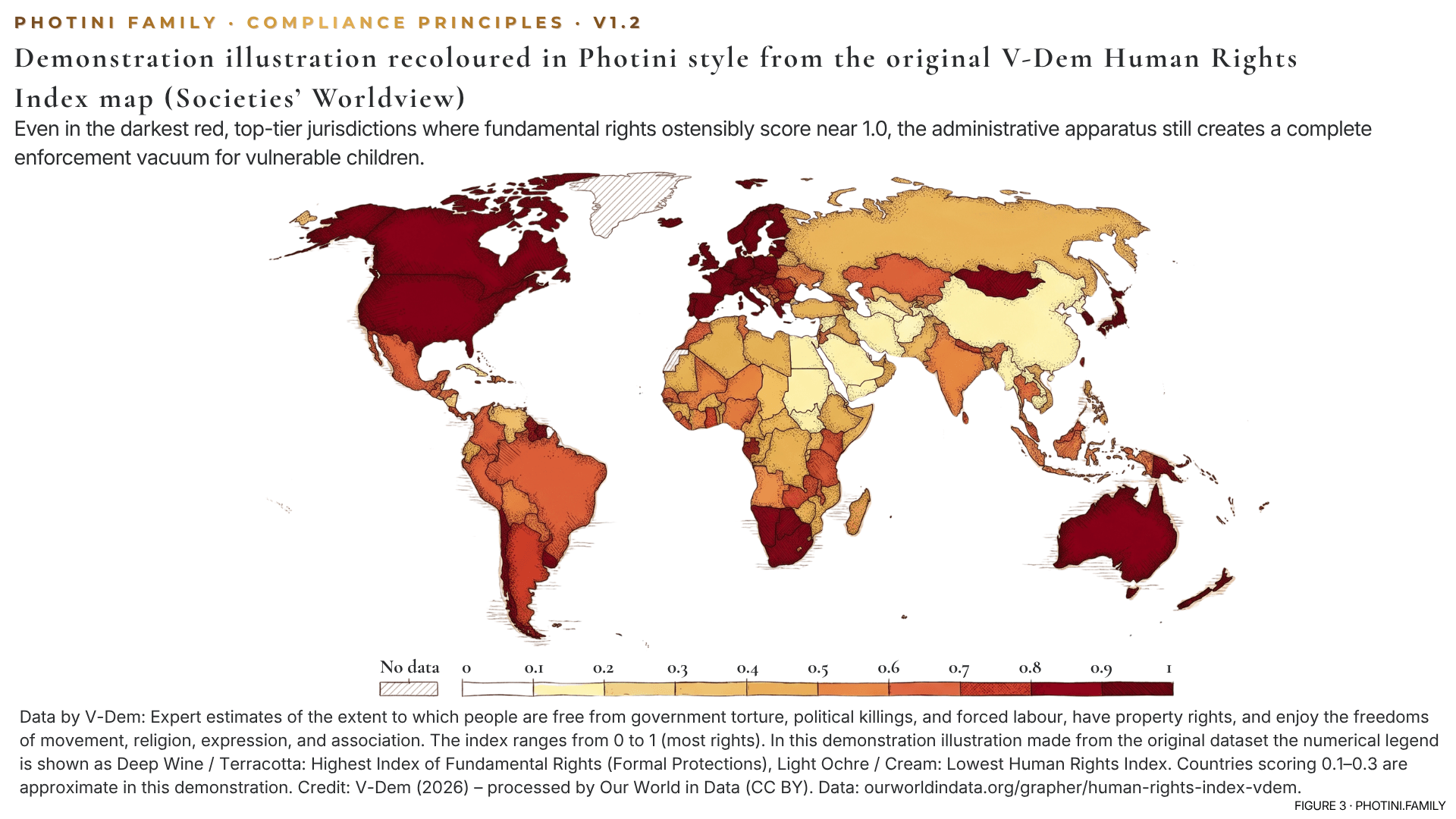
Third-party figure: V-Dem (2026), processed by Our World in Data (CC BY) — recoloured demonstration illustration; countries scoring 0.1–0.3 are approximate and the original 2026 map is archived. Source: ourworldindata.org/grapher/human-rights-index-vdem.
Primary rights — those recognized as foundational and non-derogable, such as dignity, non-discrimination, and best interests — must be respected universally, regardless of context. Yet the substance of children's rights — how they are lived, felt, and experienced — depends on active, accountable implementation.
For Photini Family, this means:
- Designing systems that make rights operational, not theoretical
- Partnering with families, communities, and professionals to close the gap between law and lived reality
- Advocating for reforms where local practice falls short of international standards
- Continuously auditing systems to ensure that children's voices and best interests are genuinely centred in every decision, measured against children's principal psychological needs (Maslow)
2.6.3 Children's Equal and Special Rights: Universal and Specific Protections
Children possess equal rights with adults because they are human beings entitled to dignity, autonomy, and protection under universal human-rights law. At the same time, they hold special rights that recognize their unique needs, vulnerabilities, and developmental realities.
Key frameworks:
- Universal Declaration of Human Rights (UDHR, 1948) [UDHR-1]: establishes that all humans are born free and equal in dignity and rights.
- International Covenant on Civil and Political Rights (ICCPR, 1966) [ICCPR-1]:
- Article 23 — Protection of the Family [ICCPR-4]: protects the family as the fundamental social unit and ensures children's protection during family dissolution or separation.
- Article 24 — Rights of the Child [ICCPR-5]: grants children special protection as minors, the right to be registered at birth, to have a name, and to acquire a nationality — preventing statelessness and ensuring legal recognition.
- UN Convention on the Rights of the Child (UN CRC, 1989) [UN-10]: the most comprehensive and widely ratified children's rights treaty, establishing children as rights-holders with specific entitlements including:
- Article 3 — Best interests as a primary consideration [UN-3]
- Article 6 — Right to life, survival, and development [UN-11]
- Article 12 — Right to be heard [UN-4]
- Articles 19, 34 and 37 — Protection from violence, abuse, exploitation, and torture [UN-7][UN-8][UN-9]
- Article 9 — Right to family unity and contact with parents [UN-6]
Why special rights matter: Children are not "incomplete adults" — they are individuals with evolving capacities who require tailored protections, participation mechanisms, and developmental support. Special rights recognize power imbalances, dependency, and the long-term impact of childhood experiences on health, identity, and social outcomes.
Other key conventions recognizing child rights:
- Convention on the Elimination of All Forms of Discrimination Against Women (CEDAW) — protects girls' rights [CEDAW-1]
- Convention on the Rights of Persons with Disabilities (CRPD) — protects children with disabilities [CRPD-1]
- International Labour Organization (ILO) Conventions — protect children from exploitation and harmful labour [ILO-1]
- Optional Protocols to the UN CRC — on armed conflict (OPAC), on the sale of children (OPSC), and on a communications procedure (OPIC) [UNCRC-OPAC][UNCRC-OPSC][UNCRC-OPIC]
2.6.4 The Global Reality: Disparities in Children's Rights Implementation
Despite universal legal frameworks, children do not enjoy equal rights worldwide. Even in countries that have ratified the UN Charter, the UDHR, the ICCPR, and the UN CRC — and are therefore legally bound to uphold children's rights — implementation varies dramatically due to weak enforcement mechanisms; political instability or authoritarianism; economic inequality and resource scarcity; cultural resistance or discriminatory social norms; and lack of accountability and transparency.
The equality principle and non-discrimination: All core human-rights instruments include categorical bans on discrimination. This means every child, everywhere, is entitled to the same fundamental rights — regardless of race, nationality, gender, religion, disability, social origin, or any other status. States that have ratified these conventions are legally obligated to ensure equal enjoyment of rights for all children within their jurisdiction.
In Europe, additional protections apply:
- European Convention on Human Rights (ECHR): binding across Council of Europe member states, with enforcement through the European Court of Human Rights (ECtHR). Article 14 — Non-discrimination [ECHR-2] reinforces that all Convention rights must be secured without discrimination. ECtHR rulings are primary-rights rulings: they create binding precedent for the respondent state and case law that clarifies and enforces the substance of children's rights across all member states.
- EU Charter of Fundamental Rights [EU-Charter-4]: applies across EU member states when implementing EU law, guaranteeing dignity, equality, and child-specific protections. Children's rights are enshrined in Article 24 — The Rights of the Child [EU-Charter-5]:
"Children shall have the right to such protection and care as is necessary for their well-being. They may express their views freely. Such views shall be taken into consideration on matters which concern them in accordance with their age and maturity. In all actions relating to children, whether taken by public authorities or private institutions, the child's best interests must be a primary consideration. Every child shall have the right to maintain on a regular basis a personal relationship and direct contact with both his or her parents, unless that is contrary to his or her interests."
All actions by EU institutions and member states must comply with these obligations, aligning with both the Charter and international conventions such as the UN CRC [UN-10]. The UN CRC, ratified by all EU member states, imposes binding standards on state parties and serves as a guiding framework for EU law and policy in this area.
Alongside the Charter, the European Union agreed the Treaty of Lisbon — a foundational reform treaty for the EU, in force since 2009 and ratified by all then-EU member states. It modernized how the EU functions, clarified the roles of its institutions, and, critically, gave binding legal force to the EU Charter of Fundamental Rights. The Treaty ensures that human rights — including children's rights — are prioritized in the law and policy of all EU member states when implementing EU law, and it explicitly commits the EU to respect the rights of the child as a Union objective, mainstreaming those protections across all areas of EU activity [EU-Treaty-1].
2.6.5 The ECtHR as Case-Law Authority: Overlaps with the ICCPR, UDHR, CEDAW, CRPD, and the UN CRC Optional Protocols
ECtHR and ICCPR [ICCPR-1]: The ECHR and the ICCPR have considerable substantive overlap in the rights and obligations they cover. Both impose obligations on states to protect children from torture and degrading treatment, ensure fair-trial rights, and guarantee effective remedies — all areas where ECtHR case law has become highly developed. The ICCPR's Article 2(3) — Right to Remedy [ICCPR-6], Article 7 — Prohibition of Torture, Inhuman or Degrading Treatment or Punishment [ICCPR-7], Article 14 — Right to a Fair Trial [ICCPR-8], and Article 26 — Equality Before the Law and Non-Discrimination [ICCPR-9] contain rights of access to courts and remedies that parallel ECHR Article 6 — Fair Trial [ECHR-3] and Article 13 — Effective Remedy [ECHR-5], providing children legal protection under both frameworks. The ICCPR (along with the UDHR) establishes fundamental access-to-justice principles that the ECtHR has interpreted and applied in child-related cases, ensuring children can obtain fair and timely remedies. Both instruments require states to ensure equal access to justice for all, including vulnerable groups such as children.
ECtHR and UDHR [UDHR-1]: The UDHR provides foundational human-rights principles that inform both the ECHR and ECtHR jurisprudence. Article 5 — no one shall be subjected to torture or cruel, inhuman or degrading treatment or punishment [UDHR-3]; Article 7 — equality before the law and protection against discrimination [UDHR-4]; Article 8 — right to an effective remedy by competent national tribunals [UDHR-5]; and Article 10 — right to a fair and public hearing [UDHR-6] establish rights to equal protection, effective remedy, and fair hearings — principles that directly influence how the ECtHR interprets Convention obligations regarding children. The overlap here is primarily in establishing universal human-rights standards that the ECtHR then applies through binding case law within the European context.
ECtHR and CEDAW [CEDAW-1]: CEDAW and ECtHR jurisprudence intersect significantly in cases involving discrimination against girls and women. CEDAW's comprehensive framework for challenging sex-based discrimination extends to girls, addressing barriers in education, child marriage, violence, and reproductive rights. The CEDAW Committee and the Committee on the Rights of the Child have issued joint recommendations highlighting intersecting forms of discrimination affecting girls — particularly indigenous girls, girls with disabilities, and those in marginalized communities. CEDAW's definition of discrimination ("any distinction, exclusion or restriction made on the basis of sex") directly overlaps with ECHR Article 14 and the protections the Court gives to girls and women experiencing violence, exclusion, or exploitation. Both supply key legal anchors for challenging sex-based discrimination and protecting against torture and degrading treatment, particularly of vulnerable girl children.
ECtHR and CRPD [CRPD-1]: The overlap between ECtHR jurisprudence and the CRPD is substantial, particularly concerning children with disabilities. Both the UN CRC and the CRPD apply to children with disabilities, with dedicated provisions (UN CRC Article 23 — Rights of Children with Disabilities [UN-12]; CRPD Article 7 — Children with Disabilities [CRPD-2]) that emphasize full enjoyment of human rights on an equal basis with other children. The UN Committees on the Rights of the Child and on the Rights of Persons with Disabilities have developed joint statements affirming a human-rights model for children with disabilities. ECtHR jurisprudence has been influenced by CRPD standards in cases involving inclusive education, reasonable accommodation, and the right to family life for children with disabilities, and the Court has increasingly recognized that violations of CRPD rights can constitute violations of ECHR fundamental rights — particularly under Articles 3 (protection from degrading treatment) [ECHR-4], 6 (fair trial) [ECHR-3], and 14 (non-discrimination) [ECHR-2].
All these UN conventions — ICCPR, UDHR, CRPD, CEDAW, and the UN CRC — establish multilayered, binding and interpretive standards obliging states to prohibit discrimination and torture. The ECtHR, as the European case-law authority, applies these principles in its judgments, compelling member states to comply and providing essential case law and actionable remedies for children's rights — including for Photini Family's advocacy and tech systems. This ensures that Europe's practical child-rights compliance is firmly rooted in both regional and global human-rights law, safeguarding children's autonomy, dignity, and holistic wellbeing in all contexts.
ECtHR and the UN CRC Optional Protocols: The UN CRC has three Optional Protocols that extend protections and create additional state obligations:
- OPAC — on the involvement of children in armed conflict [UNCRC-OPAC]
- OPSC — on the sale of children, child prostitution, and child pornography [UNCRC-OPSC]
- OPIC — on a communications procedure allowing children to submit complaints to the UN Committee on the Rights of the Child [UNCRC-OPIC]
The third Optional Protocol (OPIC) is particularly significant: it establishes an individual communications mechanism for children whose rights under the UN CRC or the first two Optional Protocols have been violated, creating a parallel remedy system to the ECtHR that allows children to seek international redress.
In the Nordic countries, the complaint system for children's rights is exceptionally weak given the structure of family law, under which children are not recognized in legal and administrative systems as autonomous rights-holders but rather as extensions of their parents, legal guardians, or the social authorities. None of the Nordic countries has a dedicated constitutional court; of the five, only Finland (ratified November 2015) and Denmark (accession October 2015) are parties to OPIC — Norway, Sweden, and Iceland have not ratified it. National complaint systems typically evaluate only whether the authority has complied with valid law (a "best interests" legality check), not children's rights as such. In essence, the Nordic countries have case law concerning children's rights mainly under criminal codes, not under children's primary rights as autonomous rights-holders — a structural gap that has led, among other things, to deportations of underage citizens and to civil-court rulings in child-abduction matters in which parents have been granted the right to determine the child's country of residence from the Nordic countries to undeveloped countries, war zones, human-trafficking situations, and environments such as Camp al-Hol. This is a primary vulnerable-children phenomenon.
For OPIC communications, the biggest challenge for children's rights is the legal structure of family laws: communications are not properly evaluated when written from the child's rights-holder point of view. Under the Optional Protocol to the UN CRC on a communications procedure (OPIC), communications written by, or primarily advancing, the guardian's rights — as opposed to those of the child as rights-holder — are likely to be found inadmissible or "not processed." OPIC requires that complaints be submitted on behalf of the child as a rights-holder, not merely from the parent's or guardian's perspective — especially if the communication advances only the guardian's rights or is not clearly in the child's best interests. The Committee "may decline to examine any communication that it considers not to be in the child's best interests," and its rules of procedure specifically include safeguards to prevent the manipulation of the child by those acting on his or her behalf.
According to research by Leiden Children's Rights Observatory child-rights experts (e.g. Jaap Doek, Leiden University [J. E. Doek 2020; J. E. Doek 2022]), a substantial percentage of communications are declared inadmissible at the registration stage because they are either manifestly unfounded, do not clearly articulate a violation of the child's rights, or are written primarily from the traditional, factual "children's rights = guardian's point of view" — not the child's. "The figures show inter alia that a vast majority of the communications submitted to the Committee did not get the substantive attention the authors wanted. This is most likely the result of a lack of awareness and/or understanding of the requirements that must be met…" [J. E. Doek 2020]. OPIC does not process communications whose substance addresses children's rights according to the cultural norm in which the factual substance of children's rights is the parents' rights. As the research notes, "many children, and not only the very young and/or those who do not (yet) have the capacity to produce a written complaint, rely on adults — but the Protocol and Committee practice require that the communication clearly advocate for the child's rights or best interests, not only the adult's, to be admissible" [J. E. Doek 2020].
Alongside OPIC communications, ECtHR jurisprudence overlaps with the Optional Protocols in cases involving sexual exploitation, trafficking, and violence against children, where the Court has developed positive obligations for states to prevent, investigate, and remedy such violations.
The European Court of Human Rights provides critical jurisprudence, for example on:
| Domain | ECtHR (ECHR case law) | UN CRC counterpart |
|---|---|---|
| Family unity and wrongful separation | ECHR Article 8 protects the right to respect for family and private life; wrongful-separation cases are evaluated in light of the best interests of the child [ECHR-1] | UN CRC Article 9 ensures children are not separated from parents against their will except when necessary for the child's best interests, and guarantees contact between children and parents if separated [UN-6] |
| Protection from torture and degrading treatment | ECHR Article 3 is an absolute prohibition of torture and of cruel, inhuman, or degrading treatment of children; used to prevent abuses in care, state action, and detention [ECHR-4] | UN CRC Article 6 (right to life, survival, and development) [UN-11], Article 19 (protection from violence, abuse, and neglect) [UN-7], Article 34 (protection from sexual exploitation and abuse) [UN-8], and Article 37 (protection from torture and cruel treatment) [UN-9] amplify these obligations by specifying the various forms of protection required for children under international law |
| Right to fair trial and effective remedy | ECHR Article 6 guarantees a fair and public hearing by an independent tribunal; Article 13 guarantees an effective remedy when rights are violated — foundational for safeguarding children's access to justice and procedural rights [ECHR-3][ECHR-5] | The UN CRC requires access to appropriate and effective remedies, participation in proceedings, access to information, and procedural protections for accused children: Articles 12 (right to be heard) [UN-4], 40 (child justice standards) [UN-13], and 42 (awareness-building) [UN-14] together reinforce procedural and remedial rights similar to ECHR standards |
| Non-discrimination | ECHR Article 14 prohibits discrimination in the enjoyment of Convention rights; it must be invoked in conjunction with another substantive right [ECHR-2] | UN CRC Article 2 requires that all rights in the Convention be granted without discrimination of any kind, regardless of the child's or the parents' status [UN-5] |
The ECtHR has the strongest substantive overlap with the UN CRC, as the Court's child-rights jurisprudence is "grounded very much in the CRC" and has been "increasingly influenced by the United Nations Convention on the Rights of the Child". The overlaps with the ICCPR, CRPD, and CEDAW are also significant, particularly in non-discrimination and equality (CEDAW, ICCPR); access to justice and effective remedies (ICCPR, UDHR); protection of children with disabilities (CRPD); and the prohibition of torture and degrading treatment (ICCPR, UN CRC, CRPD).
ECtHR and the European Social Charter [ESC-1]: the European Social Charter is the Council of Europe's counterpart to the ECHR for social and economic rights — the original Charter (CETS 35, 1961) and the revised Charter (CETS 163, 1996) protect, among other things, the right of the family to social, legal, and economic protection (Article 16) and the right of children and young persons to social, legal, and economic protection (Article 17). The ECtHR draws on the Charter when interpreting Convention rights, and its supervisory body — the European Committee of Social Rights — operates a collective-complaints mechanism (CETS 158) through which organizations can challenge systemic failures without an individual victim; notably, Finland is the only state party whose Article 2 declaration extends standing to representative national NGOs. For Photini Family, the Charter supplies the social-rights flank of the same architecture: the fundamental needs at Points 1–4 of the Photini Family Pyramid (Figure 1) in treaty form.
The ECtHR performs strongest in remedying actual violations through binding judgments, while UN treaty bodies provide broader interpretive guidance and standards. Together, these frameworks create a comprehensive, multilayered system of children's rights protection that states must navigate and implement at national level. ECtHR rulings are primary case-law rulings for children in Europe with which all member states must comply, and for Photini Family the ECtHR — as well as other recognized courts — provides important case law for children's rights.
Other recognized courts and authorities:
- Inter-American Court of Human Rights (IACtHR)
- African Court on Human and Peoples' Rights
- UN Committee on the Rights of the Child (issues General Comments and reviews state compliance)
- National constitutional courts interpreting children's rights (note: none of the Nordic countries has a dedicated constitutional court)
In practice: While legal frameworks are increasingly robust, the gap between rights on paper and rights in reality remains vast — especially for marginalized, immigrant, minority, and disabled children. Photini Family's mission is to document, expose, and close these gaps through evidence, advocacy, and rights-based technology.
2.6.6 Photini Family's Supreme Principles on Children's Rights
Photini Family's ethical framework and all operations are anchored in the highest available standards of children's rights protection, drawing from:
- ICCPR — special rights for children - Article 23 — Protection of the Family: protection of the family and safeguards for children during family separation or dissolution [ICCPR-4] - Article 24 — Rights of the Child: every child's right to protection as a minor, legal identity, registration, name, and nationality [ICCPR-5]
- UN CRC — the comprehensive children's rights framework. All UN CRC articles guide Photini Family's work, with particular emphasis on: Article 2 (non-discrimination) [UN-5]; Article 3 (best interests of the child) [UN-3]; Article 6 (right to life, survival, and development) [UN-11]; Article 9 (protection from wrongful separation and right to family contact) [UN-6]; Article 12 (right to be heard) [UN-4]; Article 19 (protection from violence, abuse, and neglect) [UN-7]; Article 34 (protection from sexual exploitation and abuse) [UN-8]; Article 37 (protection from torture and cruel treatment) [UN-9].
- Regional and international protections - ECHR — especially Articles 3 (protection from degrading treatment), 6 (fair trial), 8 (family life), and 14 (non-discrimination) [ECHR-1][ECHR-2][ECHR-3][ECHR-4] - EU Charter of Fundamental Rights — especially Articles 1 (human dignity), 20 (equality before the law), 21 (non-discrimination), and 24 (the rights of the child) [EU-Charter-1][EU-Charter-2][EU-Charter-3][EU-Charter-5] - UDHR and ICCPR universal rights provisions [UDHR-1][ICCPR-1]
- Other key conventions - CEDAW (protecting girls) [CEDAW-1] - CRPD (protecting children with disabilities) [CRPD-1] - ILO Conventions (protecting children from exploitation) [ILO-1] - Optional Protocols to the UN CRC [UNCRC-OPAC][UNCRC-OPSC][UNCRC-OPIC] - Council of Europe Lanzarote Convention (CETS 201) — protection of children against sexual exploitation and sexual abuse, including within the family and the circle of trust [COE-Lanzarote-1] - Council of Europe Istanbul Convention (CETS 210) — preventing and combating violence against women and domestic violence, with protection duties extending to children exposed to it [COE-Istanbul-1] - EU Victims' Rights Directive (2012/29/EU) — minimum standards for the rights, support, and protection of victims of crime, including child victims [EU-Victims-1]
The Committee's General Comments — the Convention's operating manual. The UN Committee on the Rights of the Child's General Comments carry the Convention's authoritative interpretive guidance, and three of them anchor Photini Family's substance standard in particular: General Comment No. 12 (2009) on the right of the child to be heard — the methodology for hearing children and giving their views due weight in all matters affecting them [CRC-GC12]; General Comment No. 13 (2011) on the right of the child to freedom from all forms of violence — the comprehensive protection standard behind Points 1–4 of the Photini Family Pyramid (Figure 1) [CRC-GC13]; and General Comment No. 14 (2013) on the best interests of the child — which defines best interests as a substantive right, a fundamental interpretative legal principle, and a rule of procedure, requires formal processes with strict procedural safeguards, and extends obligations to the private sector [CRC-GC14].
The paradox: robust legal frameworks, invisible children. Children are among the most protected groups in international law. An unprecedented volume of conventions, treaties, protocols, and legal standards explicitly guarantee their rights. Yet despite this expansive legal architecture, millions of children fall through the cracks — denied justice, silenced, separated from families, and rendered invisible within systems that claim to protect them.
The "parental rights" barrier: when protection becomes exclusion. One of the most insidious mechanisms enabling this justice gap is the misuse or over-prioritization of parental rights — or social authorities' rights — to override children's independent rights. In many legal and administrative systems, children are not recognized as autonomous rights-holders but rather as extensions of their parents, legal guardians, or the government through social authorities. This creates situations where:
- Children's voices are ignored or dismissed because parents or social authorities have the "right" to speak for them — even when the parents' or social authorities' interests conflict with the child's welfare.
- Access to justice is denied because children cannot initiate legal proceedings, file complaints, or access evidence without parental or social-authority consent — even when parents are the alleged perpetrators of harm.
- Separation from family becomes indefinite or wrongful because parental rights are used to justify keeping children in harmful situations or, conversely, to block reunification without proper judicial review or child participation.
- Privacy and confidentiality are weaponized to prevent children, advocates, or even courts from accessing critical information about the child's situation, needs, or abuse.
- Systemic discrimination is concealed because parents — especially immigrant, minority, or marginalized families — face procedural barriers, language exclusion, or cultural bias, and their children's independent claims are never heard. This is compounded by weak or falsified documentation by authorities and by major data gaps, the reasoning behind which at worst refers to the protection of children and immigrants because of the misuse of statistical racial information in World War II [Nordic Council of Ministers, 2024].
2.6.7 The Children's Justice System: Why Family Law Removes Children from Constitutional Justice
In a "normal" justice system, justice is typically served through the constitutional triangle:
A constitutional justice system is built on foundational principles that ensure law is created, interpreted, and enforced in ways that protect rights, promote fairness, and limit the abuse of power. Central among these are the rule of law, the separation of powers, and access to justice and fair trial. (This is the institutional architecture behind the triangle introduced in Section 2 — see Figure 4.)
- Separation of powers. Governmental authority is divided into distinct branches — the lawmaker (legislature), the investigator/enforcer (executive or police), and the adjudicator (judiciary or courts) — because the division of power prevents the concentration of power and promotes checks and balances. It prevents abuse of power (no single entity controls law-making, law enforcement, and judicial decision-making) and ensures fair process (each branch has distinct responsibilities and checks on the others).
- Rule of law. All public authorities, citizens, and institutions are subject to and accountable under the law. No one is above the law. All actions, from investigation to court ruling, must be grounded in established law — never arbitrary will or unchecked authority. The system must ensure predictability, equality before the law, and protection of fundamental rights.
- Access to justice and fair trial — due process and procedural safeguards. Everyone is entitled to impartial and independent judicial proceedings, the presumption of innocence, and procedural rights ensuring fair treatment. Justice requires procedural law — a set of rules governing how cases are investigated and adjudicated (e.g. the criminal code) — that guarantees the presumption of innocence, secures rights to defence, public hearing, and impartial judges, and enables fair and effective remedies for rights violations.
Why the separation matters, branch by branch:
Lawmaker (legislature) — drafts and enacts laws in line with the constitution and human-rights standards; it must not participate in enforcement or judicial review, to avoid self-serving or politically motivated law enforcement. The legitimacy of law depends on democratic processes and public participation. Obligations toward human rights and children's rights:
- Incorporation: legislatures are obligated to incorporate international conventions, treaties, protocols, and binding instruments — including the UDHR, ICCPR, CEDAW, ECHR, UN CRC, OPAC, and OPSC — into domestic law and policy frameworks.
- Compliance and harmonization: statutes and regulations must align with the principles, minimum standards, and explicit rights guaranteed by these instruments (e.g. non-discrimination, equality before the law, rights of the child).
- Progressive realization: legislatures have a duty to progressively realize social and economic rights, ensuring continual improvement and never regressing from established protections.
- Participation and transparency: democratic lawmaking demands public consultation, including mechanisms for children's participation (per UN CRC Article 12 — the right of the child to be heard in all matters affecting them).
- Non-enforcement / non-adjudication: legislatures must avoid direct enforcement or interpretation — protecting the separation of powers and preventing conflicts of interest.
Investigator (police / executive) — applies the law in practice, investigates facts, and upholds order within legal limits; it must not decide guilt or create laws, to avoid conflicts of interest and the fabrication of charges. Allowing investigators to create or adjudicate law leads to arbitrary enforcement and loss of public trust. Obligations:
- Respect and protect: police and executive authorities must respect, protect, and fulfil all rights and freedoms codified in international instruments — including prohibitions on torture or inhuman treatment (ICCPR, ECHR), safeguarding children from abuse (UN CRC, OPSC), and non-discrimination (UDHR, CEDAW).
- Due process and legitimate use of power: all investigative actions must adhere to procedural guarantees (right to liberty, presumption of innocence, child-appropriate legal processes, access to counsel).
- Best-interests principle: where children are involved, decisions and investigations must be guided by the child's best interests (UN CRC Article 3 [UN-3]).
- Judicial oversight and accountability: executive acts must be subject to judicial review and independent oversight — fundamental to preventing abuse, arbitrariness, and injustice.
- No legislative or judicial role: the executive is strictly confined to enforcement and administration, not lawmaking or adjudication, ensuring clarity and legitimacy.
Court (judiciary) — interprets laws, determines guilt or innocence, and issues rulings; it must remain impartial, independent, and insulated from political or executive pressures. Courts interpret the law, resolve disputes, and review the actions of lawmakers and investigators, ensuring that legal processes are followed and rights respected. Obligations:
- Interpret and apply international standards: courts are bound to interpret and apply domestic law consistently with ratified international instruments, especially those concerning human rights and children's rights.
- Judicial independence and impartiality: judges must remain independent, impartial, and free from external influence — including from legislators and executives — per international standards (ICCPR Article 14 [ICCPR-8]; ECHR Article 6 [ECHR-3]):
"All persons shall be equal before the courts and tribunals. In the determination of any criminal charge against him, or of his rights and obligations in a suit at law, everyone shall be entitled to a fair and public hearing by a competent, independent and impartial tribunal established by law." (ICCPR, Article 14(1))
"Everyone is entitled to a fair and public hearing … by an independent and impartial tribunal established by law." (ECHR, Article 6(1) [ECHR-3])
ICCPR General Comment No. 32 (paras 15, 21) clarifies: impartiality means judges must not allow bias or be influenced by other interests; independence must be both institutional and individual. ECtHR case law defines independence as freedom from interference by other branches, security of tenure, guarantees against outside pressure, and impartiality both subjectively and objectively.
- Access to justice: ensure effective remedies and uphold children's access to justice (UN CRC, ICCPR), including specialized procedures for children, timely hearings, and the right to express views.
- Review of state compliance: the judiciary serves as a check on the legislative and executive branches, reviewing the conformity of their actions with international obligations.
- Child-friendly approach: legal processes must be adapted to support children's participation, understanding, and psychological safety (UN CRC, General Comment No. 12 [CRC-GC12]).
Landmark case law — ECHR:
- Hauschildt v. Denmark (1989): the ECtHR found a violation where the same judge was involved in pre-trial decisions and the final judgment. Independence and impartiality must be objectively justified.
- Bryan v. United Kingdom (1995): the ECtHR outlined factors for independence: the appointment process, term of office, guarantees against pressure, and the appearance of independence and impartiality.
- Wałęsa v. Poland (2023): the ECtHR found that irregular judicial appointments and executive interference violated Article 6(1) — judicial independence is crucial to the right to a fair trial.
- Grzęda v. Poland (2022): undermining judicial independence through political interference in judicial appointments was found to violate fair-trial rights.
- Pullar v. United Kingdom (1996): the ECtHR specified two aspects of impartiality: subjective (no personal bias) and objective (the court presents enough guarantees to exclude legitimate doubt).
- Juszczyszyn v. Poland (2022): the ECtHR held that judicial independence is a precondition of the rule of law; the judgment was the first against Poland to find a violation of Article 18 (in conjunction with Article 8) — recognizing Article 18 as a pillar for the separation of powers and judicial independence.
Judges must be free from external and internal pressures — including those from the executive, the legislature, and within the judiciary itself. Judicial appointments, tenure, and protection from arbitrary removal or interference are essential. The institutional guarantees of judicial independence and impartiality protect all other rights.
Juridical principles underpinning constitutional systems:
- Legality (nullum crimen, nulla poena sine lege): no person can be punished except for violation of a law previously established.
- Judicial independence: courts operate independently from both lawmakers and investigators; judges must be free from direct or indirect influence — preventing political, social, or executive interference in case decisions.
- Impartiality and due process: judges must decide cases based only on law and evidence, not outside pressures or interests. Legal processes — arrest, investigation, trial — must be fair, transparent, and respect both the rights of individuals and the interests of society.
- Equality before the law and presumption of innocence: all persons, regardless of status, are entitled to equal protection and equal treatment under the law; every person is presumed innocent until proven guilty according to law.
- Accountability and transparency: all branches are accountable — courts via published rulings, police through oversight mechanisms, lawmakers to the electorate and constitutional review. Processes are open, reasoned, and documented, enabling scrutiny, appeals, and confidence in the justice system.
The triangle in practice (see Figure 4, Section 2): Law sits at the top — all actions flow from written statutes and constitutional principles, the law made by the legislature. The court and its rulings (judiciary) decide cases based on law, facts, and procedural fairness. Police and investigators (executive) enforce and investigate based on legal authority, presenting cases to courts. At the centre, procedural law (e.g. the criminal code) binds all parties, structures the justice process, and secures human rights — distinct from constitutional law, procedural guarantees serve as protection for human rights within "normal" justice.
Why separation matters: It prevents abuse of power — if a single body or person defines the law, investigates offences, and decides guilt, there is no meaningful accountability; the result is arbitrary and potentially tyrannical government. It ensures impartiality — judges independent of lawmakers and investigators. It protects fundamental rights — laws applied fairly, investigations conducted lawfully, trials conducted impartially, upholding constitutional rights including due process and equal protection. The constitutional justice system is a bulwark against tyranny and injustice. Failure to separate these functions leads to abuses of power, biased justice, and the erosion of trust in the rule of law — a threat to human rights and constitutional democracy.
As jurisprudence, however, children's rights generally look different: children are removed from the main justice system with the help of family laws — Child Welfare Acts, child-protection laws, guardianship laws, custody laws, juvenile laws, adoption laws.
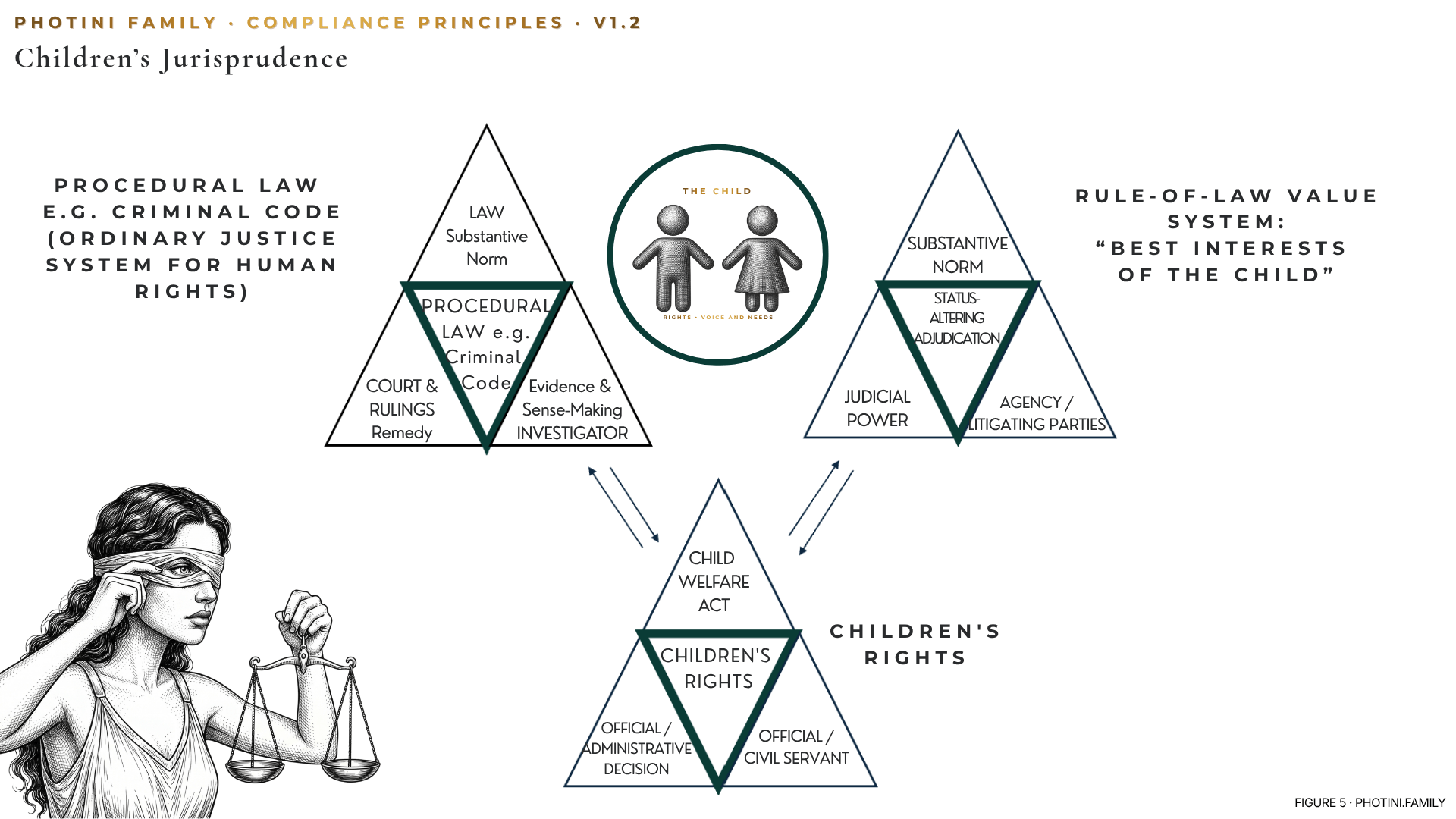
The children's justice system: origin, structure, and reasoning. Children's justice systems — also called child-protection, family, or welfare jurisdictions — arose from the recognition that children have unique vulnerabilities, developmental needs, and rights. Historically, the classical criminal justice system was designed for adults and failed to account for children's dependency and the complexity of family circumstances.
Historical reasoning: The late 19th and 20th centuries saw social reformers argue that treating children like adults in courts and police systems ignored their developmental status and right to protection. Landmark international standards — above all the UN CRC — established children as rights-holders, not just objects of protection. The emergence of child-welfare acts and specialized courts reflected the need for tailored approaches: preventing harm, supporting families, and focusing on rehabilitation. Family-law-based children's justice systems (child-welfare acts, administrative decisions by officials and civil servants) evolved from a societal belief in the "protective" role of the state and family — historically prioritizing welfare and protection over adversarial justice or individual rights. These systems are built around the idea that children are vulnerable, dependent, and in need of safeguarding, so conflict and major life decisions (custody, welfare interventions, protection from abuse or neglect) are resolved through administrative, non-criminal frameworks — often without the formal guarantees found in constitutional (criminal/civil) systems.
Key features:
- Administrative process: decisions are made by social workers, civil servants, and officials applying child-welfare statutes — rather than judges applying constitutional law or human-rights standards. Proceedings are less adversarial, guided by the "best interests of the child" as presented by the social authorities.
- Child-rights position: historically, children were viewed as objects of protection, not subjects of rights; parental, institutional, or state interests predominated.
- Legal review: oversight comes through appeals or complaints to administrative courts — not regular judicial tribunals — and often focuses on whether laws and procedures were followed, not on substantive rights violations.
Structural comparison:
| Aspect | Family-law-based children's system | Normal constitutional justice system |
|---|---|---|
| Primary law | Child Welfare Acts, family law, administrative law | Criminal code, penal code, procedural law, constitutional law |
| Decision-makers | Social workers, officials, administrative bodies | Police, prosecutors, judges and courts |
| Focus | Welfare, protection, social work, the child's needs, family situation, child development | Justice, accountability, rights violations, individual acts, culpability |
| Purpose | Protection, rehabilitation, best interests | Punishment, deterrence, justice |
| Subject position | Children seen as wards / protected individuals | Children (if parties) have standing and agency |
| Process | Investigative, administrative, less adversarial | Adversarial trial |
| Appeal / review | Administrative appeals; rarely constitutional review | Full judicial review, constitutional guarantees |
Rationale for a separate system:
- Developmental science: children's cognitive and emotional development is not mature — it requires protective and rehabilitative responses, not punitive ones.
- Best-interests principle: family law prioritizes the child's best interests, demanding individualized, holistic assessments.
- Preventive and therapeutic focus: the system aims to support and remedy family circumstances instead of merely punishing violations of law.
- Participation rights: children have procedural rights (to express views, to representation) tailored to their level of understanding — though in practice this often narrows the child's voice.
- Protection from criminalization: children are shielded from harsh adult criminal processes and instead encounter systems better equipped to address trauma, psychological needs, and rehabilitation.
Children's voices and best interests are formally considered in all decisions — in theory, at least. In many societies children have, in substance, no voice before a certain age that is usually well above ten years old; children in custody usually have an even weaker voice.
Risks and challenges:
- Overreach and arbitrary interventions: administrative bodies sometimes wield significant discretionary power, risking insufficient due process.
- Gaps in representation: not all children have direct legal representation, and some systems are slow to recognize children's voices.
- No customer-side control loop: these risks are compounded because child-welfare systems rarely document the customer viewpoint — the child's and family's own feedback — or run any rehabilitation-development cycle against it. The absence of COSO- or ISO-style operational controls (risk frameworks, quality management, corrective feedback loops) means the system has no mechanism to detect, measure, or correct its own failures — the performance-expectation gap in concrete form.
Systemic improvements: Modern systems increasingly embed safeguards — mandatory legal counsel, child-friendly processes, periodic review of placements, and international oversight. The creation and continual refinement of the children's justice system through family laws reflects society's understanding that children are distinct rights-holders. This separation from the adult system enables justice tailored to children's developmental needs, upholds their fundamental rights, and embodies international human-rights commitments — fundamentally shaping how societies respect and support childhood.
For children for whom one or both parents — or the child — fall under an Aliens Act or equivalent immigration law, the jurisprudence looks different again:
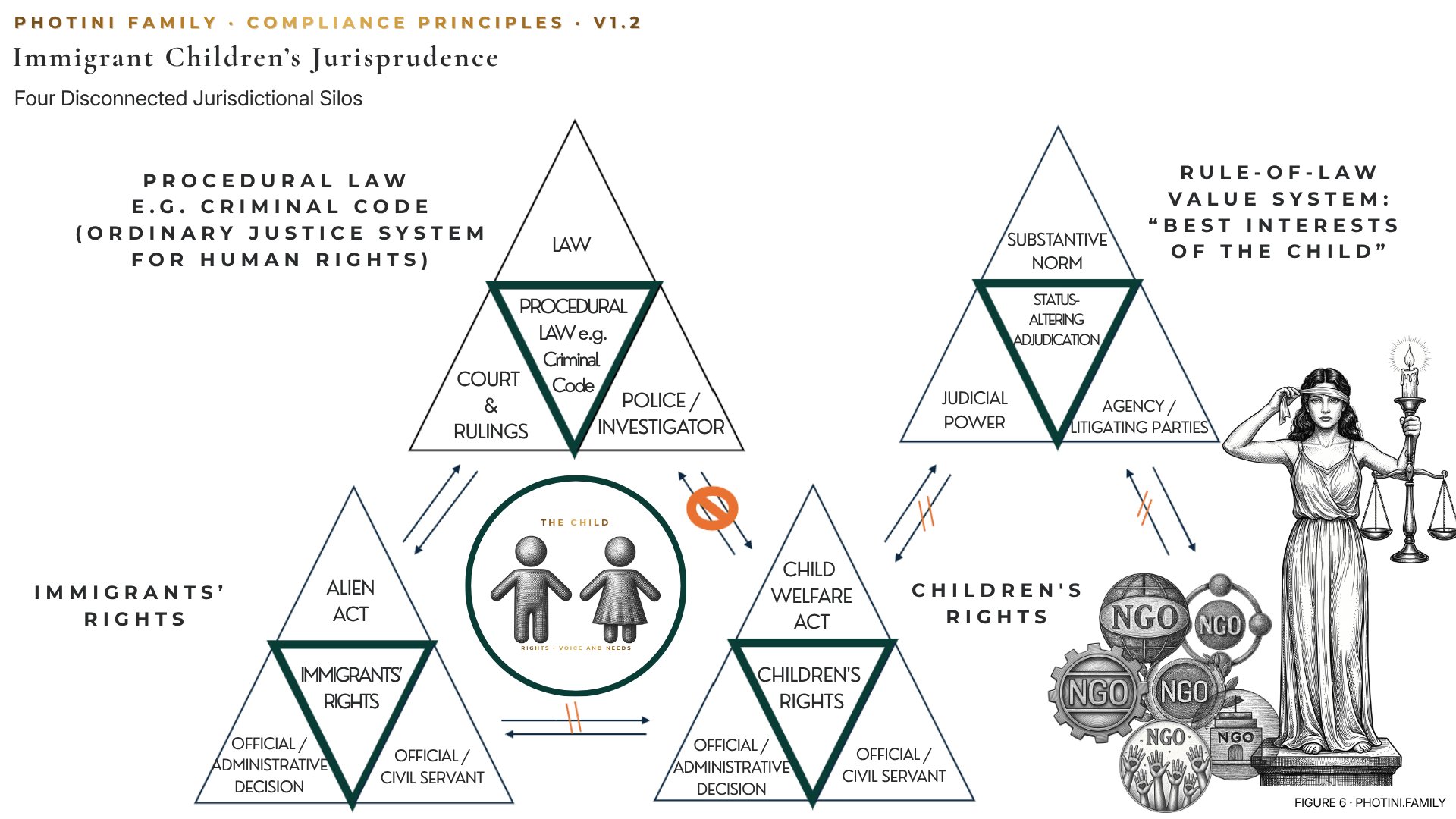
Immigrant children have never had equal rights compared to native children because of immigration laws — and no children have ever had equal rights compared to adults in many legal and administrative systems, because children are not recognized as autonomous rights-holders, although they are under all international conventions. For immigrant children, crime prevention therefore looks different — especially in situations where the criminal code fails to recognize the human-rights violation as a crime that would recognize the victim, or where the police decide not to prevent or investigate a crime and do not treat the child as a victim:
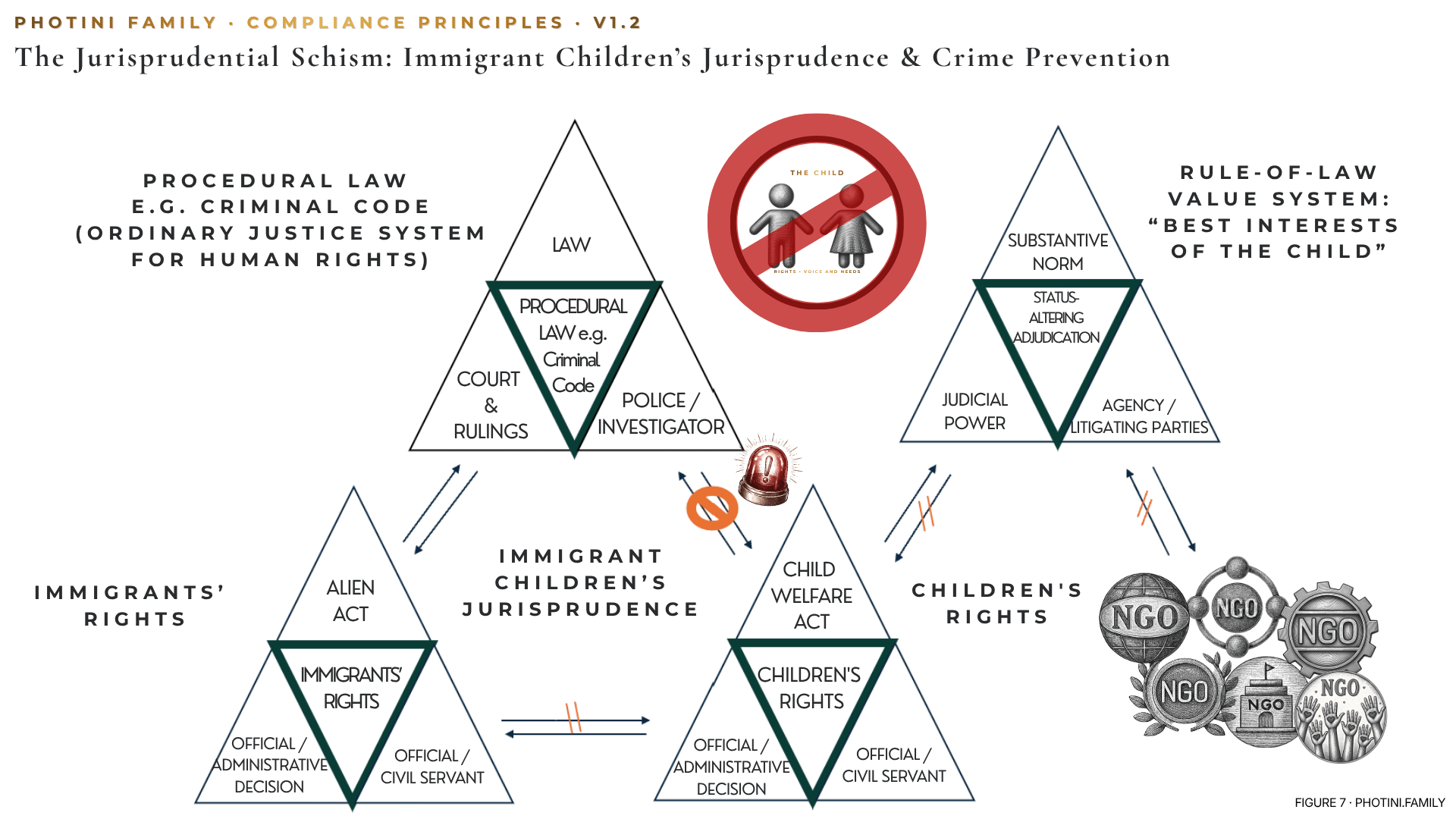
Case Finland shows what this jurisprudence produces at its most severe: vulnerable children in the void — children who fall out of every jurisdictional silo at once. Because the immigration office does not co-operate with social authorities or with the police, crime prevention and crime investigation concerning children are in substance outsourced to the social authorities, and this jurisprudence has led — and still leads — to deportations of underage citizens. Abductions and cross-border custody impasses proceed without any form of crime prevention, and child-welfare reporting from the social authorities is very weak (at worst, social authorities seek sole custody for a parent who threatens to abduct the child or who is reported for other forms of domestic violence). Photini Family's Case Finland research documentation records the scale of the affected cohorts; those figures are maintained on photini.family so they can be corrected, amended, and re-sourced in one place as the research develops. (See Figure 8 for the vulnerable cohorts caught in these gaps.)
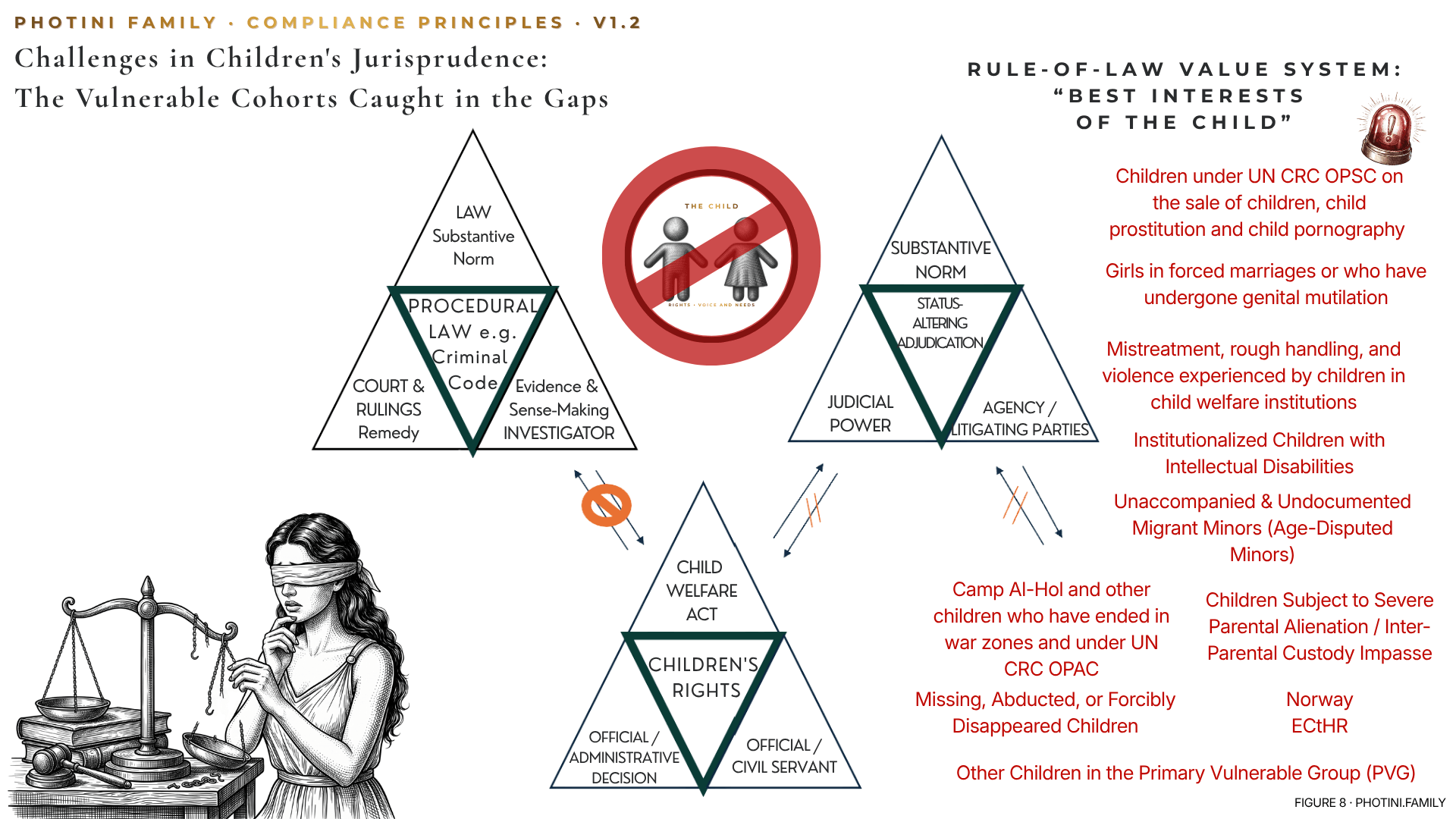
How children lose their rights — structural failures:
- No independent legal standing: many jurisdictions do not grant children the right to independent legal representation, complaint mechanisms, or access to courts without parental or guardian consent — or, at worst, the social authority's consent (for example, children in custody or orphans).
- Parental veto over evidence: parents, guardians, or authorities may control access to medical records, school reports, therapy notes, and case files — preventing children or their representatives from documenting harm or building cases for protection.
- Conflation of "family rights" and "parental rights": systems often assume that what serves parental or social officers' authority automatically serves the child's best interest — ignoring power imbalances, abuse, neglect, or coercion within families.
- The outsourcing loop: social authorities increasingly outsource the core of their own mandate — assessments of circumstances (the Finnish olosuhdeselvitys), the hearing of the child, and visitation arrangements — to external institutions or third-party providers, much as care interventions are outsourced. These entities, in turn, delegate the decision-making back to the social welfare authorities. The result is a loop in which no one ultimately holds a genuine understanding of the child's core being, voice, or actual situation: efforts to address or manage the child's circumstances are hindered, the meaningful role that child-welfare services should play is undermined, and in the worst case the child is misdiagnosed. The loop is visible in individual complaints, in white papers, and in systemic rulings from legal supervisors — and the moral authority of social authorities declines the more they are measured against the fundamental-protection parameters they are supposed to secure (Points 1–4 of the Photini Family Pyramid, Figure 1). The lived result for the child is the collapse of fundamental protection itself (see Figure 9).
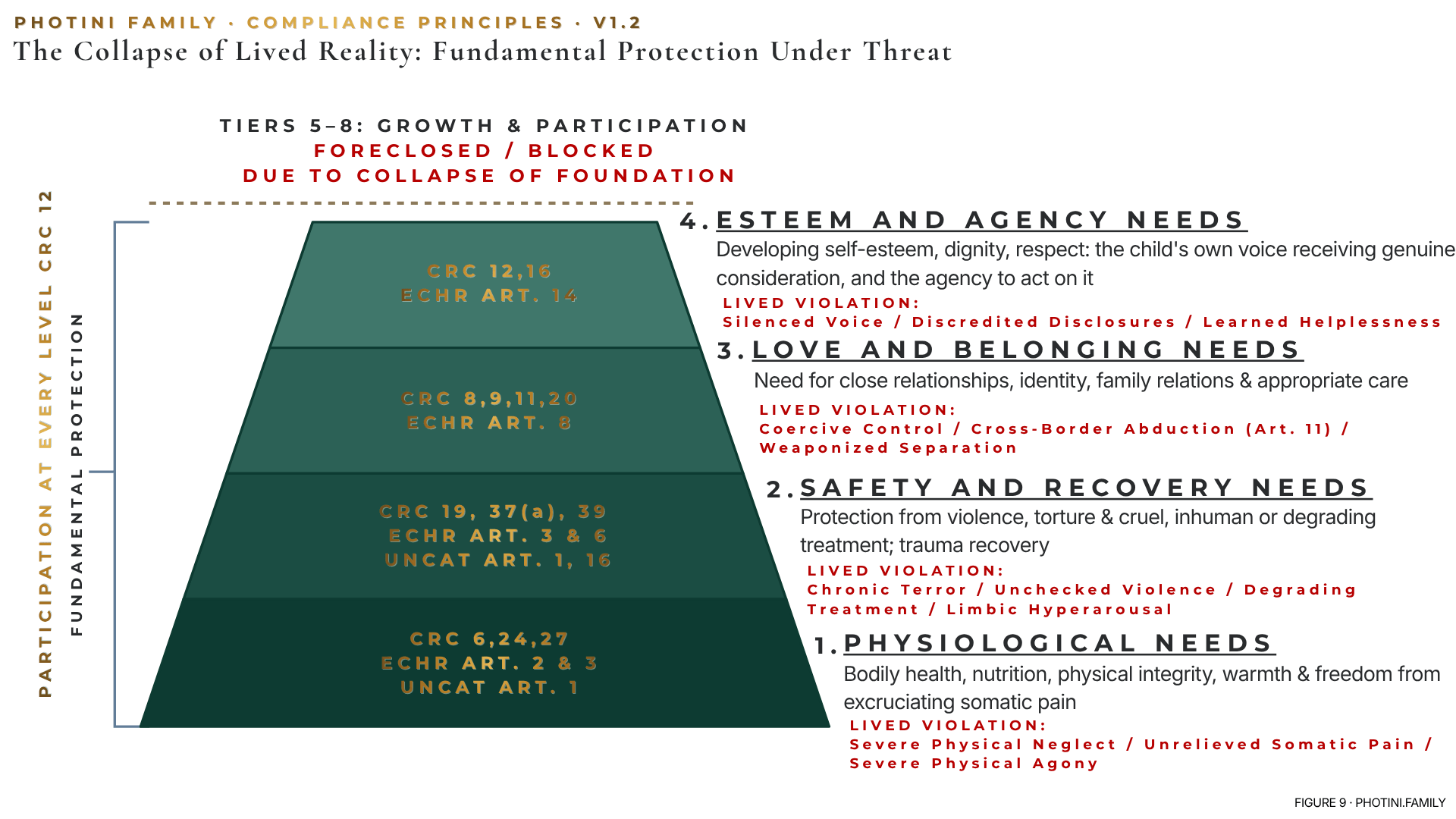
- Institutional gatekeeping: child-protection agencies, family courts, and social services may prioritize family unity, custody, or parental rights over the child's expressed wishes, safety concerns, or trauma experiences — at worst, over their human rights — especially when children are very young, disabled, or non-native speakers.
- Discriminatory application: immigrant, refugee, and minority families face disproportionate scrutiny and separation — while simultaneously being denied transparent processes, interpretation, or the right to challenge evidence. Their children become doubly invisible: excluded by systems, silenced by language and bias — at worst also by fears and trauma.
In essence: when children do not hold individual rights at the substance level, and their rights are bonded either to parental rights (the parent as "owner" of the child) or to government rights (the social authority's "possession rights" over the child), the evaluation of the substance — both in the original decision and afterwards in complaint systems — becomes unstable, because the substance is never evaluated against the rights of the child. The "best interests of the child" is a concept subject to interpretation — and under that interpretation, the best interests of the child can be used to justify the complete loss of the rights of the child.
The result: children outside justice. When children fall into this gap, they experience:
- Voicelessness: their perspectives, fears, and needs are unheard or actively suppressed. They also do not receive the correct treatment for their situation from their environment (daycares, schools, healthcare) — which easily worsens their condition, silences them, and leads to misinterpretations and misconduct.
- Prolonged harm: abuse, neglect, or exploitation continues because the child cannot access help independently. At worst, children lose their parent, parents, or other relevant close relations or relatives in weak justice systems as counter-reactions, misconduct, or misinterpretation by authorities and their environment.
- Wrongful separation or detention: families are torn apart and kept apart based on incomplete evidence, discriminatory assumptions, or lack of due process. At worst, children lose contact with their family members, the other parent or parents, their citizenship — and with it the human rights and constitutional rights granted on that basis — and disappear either inside the society or outside the country of origin.
- Loss of identity and dignity: children lose legal recognition, nationality, or documentation — especially in cases of statelessness, unregistered births, residency decisions, or disputed custody.
- Loss of all aid measures: children and their parents lose their primary rights to all aid remedies for their situation when the child's primary rights become secondary to the authorities' rights (bias) — when the evaluation can be made on the basis of the "best interests" of the child instead of the rights of the child.
- Intergenerational trauma: the failure to protect children's rights perpetuates cycles of harm, mistrust, and exclusion — in societies that do not even recognize trauma as a condition in child psychiatry and do not provide children any treatment for it before they are adults, for example in Finland.
- Loss of justice: children lose their right to justice when both crime prevention and crime detection are made the responsibility of the parent or parents instead of the government's obligation to protect children's primary rights according to international conventions and constitutions. Victims are left without even minimal rights: the child's primary rights can become secondary to the authorities' rights whenever the evaluation is made on the basis of the "best interests" of the child instead of the rights of the child — including when the child faces the threat of violence, neglect, or actual violence.
Why this happens: the theoretical vs. practical rights gap. Conventions establish rights on paper, but enforcement depends on:
- Political will: governments must allocate resources, train personnel, and hold institutions accountable.
- Accessible mechanisms: children need child-friendly complaint procedures, legal aid, and independent advocates.
- Cultural shift: societies must recognize children as persons with rights — not property, or extensions of parents' or authorities' rights.
- Systemic transparency: secrecy, closed proceedings, and gatekeeping must be replaced with open, reviewable, participatory processes with clear controls and KPIs.
- Intersectional awareness: protections must address compounded vulnerabilities — disability, migration status, language, poverty, gender.
- Missing substance-level due process: children's rights have no equivalent of the criminal-justice rulebook — no "pre-trial investigation act" (the Finnish esitutkintalaki) on the child's side, no evidence and hearing standards for the circumstances assessment (olosuhdeselvitys) comparable to the rules that govern police investigation, and no procedural safeguards matching what even the International Criminal Court's Rules of Procedure and Evidence provide. When substance-level performance is not written as a control, it becomes a performance-expectation gap: every actor can claim compliance while no one is measured against the child's actual outcome. The UN Committee addresses exactly this gap in General Comment No. 14, which requires States to "put in place formal processes, with strict procedural safeguards" for assessing and determining the child's best interests — a rule of procedure that family-law systems have not implemented [CRC-GC14].
When these elements are absent, conventions remain symbolic, offering no real protection to children in crisis. As long as children's rights are not written from the children's perspective in family laws, children's rights will not develop — nor will research and services provided to children and their families.
The role of parental rights: balance, not domination. Parental rights are legitimate and necessary — they protect family integrity, cultural transmission, and the primary role of parents in raising children. But parental rights (like social authorities' rights) are not absolute. They exist in service of the child's welfare, not in opposition to it. International law is clear:
- UN CRC Article 3: the best interests of the child are a primary consideration — they can override parental preferences when those preferences cause harm.
- UN CRC Article 12: children have the right to express views and have them given due weight — regardless of parental consent.
- ECHR Article 8: family life is protected, but interference is justified when necessary for the child's protection.
- ICCPR Article 24: children have independent rights to protection, identity, and nationality.
The balance: parents should have authority to care for and represent their children in most circumstances. But when parental authority or social authority conflicts with the child's safety, dignity, voice, or rights, the child's independent interest must prevail — and the child must have access to independent advocacy and remedy.
Photini Family's response. Photini Family's mission directly addresses this justice gap by:
- Empowering children's independent voice and rights: all platforms enable children to report, document, and participate — without parental or social-authority gatekeeping.
- Documenting systemic failures: research and advocacy expose cases where parental rights are misused to silence children or deny justice or aid measures.
- Supporting transparent processes: technology and evidence tools ensure that children, families, and advocates have access to information — challenging secrecy and procedural exclusion.
- Championing legal reform: advocating for child-friendly complaint mechanisms, independent legal representation, and enforceable accountability for violations.
- Developing services and rehabilitation around voice and needs: Photini Family's development aim is service design and rehabilitation development that respond directly to the child's voice and needs — protecting the child's fundamental principal needs (Figure 1, Points 1–4) alongside their legal rights, and treating feedback and rehabilitation outcomes as controls, not afterthoughts.
- Centring marginalized children: prioritizing immigrant, minority, and disabled children, who face the greatest barriers to justice and their rights — because solutions built for the most vulnerable elevate every child's rights and services across the whole of society.
2.6.8 Photini Family's Principles over Children's Rights in Substance
Chapter 2.6 establishes that children's rights are both universal human rights and specialized protections. Photini Family commits to the highest legal and ethical standards globally, centring the voices, dignity, and best interests of every child — especially those most at risk of exclusion, harm, or systemic discrimination.
ICCPR, Article 24 — Rights of the Child [ICCPR-5]
Text: "1. Every child shall have, without any discrimination as to race, colour, sex, language, religion, national or social origin, property or birth, the right to such measures of protection as are required by his status as a minor, on the part of his family, society and the State. 2. Every child shall be registered immediately after birth and shall have a name. 3. Every child has the right to acquire a nationality."
What it means: Children are entitled to specific protective measures because of their status as minors — from family, society, and the state. All children hold these rights without discrimination on any ground. Every child must be registered at birth, given a name, and granted nationality — ensuring legal recognition and protection from statelessness. Families, communities, and states share responsibility for upholding children's rights and protection.
How Photini Family applies it: All systems, processes, and advocacy recognize that children require additional protections due to their developmental stage and vulnerability — informing age-appropriate consent, trauma-sensitive design, and family-integrity protections. Documentation and advocacy platforms ensure that no child is made "invisible" or denied access to systems due to lack of registration, nationality, or status: every child must be seen, counted, and protected as a rights-holder. All child-facing services and tools guarantee equal treatment and protection regardless of race, origin, language, religion, or any other status — directly supporting immigrant, minority, and marginalized children. And Photini Family partners with families, communities, professionals, and state actors to create ecosystems of care and accountability — never siloing responsibility or blaming families.
ICCPR, Article 23 — Protection of the Family [ICCPR-4]
Text: "1. The family is the natural and fundamental group unit of society and is entitled to protection by society and the State. 2. The right of men and women of marriageable age to marry and to found a family shall be recognized. 3. No marriage shall be entered into without the free and full consent of the intending spouses. 4. States Parties to the present Covenant shall take appropriate steps to ensure equality of rights and responsibilities of spouses as to marriage, during marriage and at its dissolution. In case of dissolution, provision shall be made for the necessary protection of any children."
What it means: The family is recognized as the foundational social unit deserving protection from both society and the state. When families separate or dissolve, children must receive necessary protection — maintaining relationships, ensuring welfare, and preventing harm. States must actively protect family integrity and ensure that children's rights and well-being are safeguarded during family crises or separations, with equal rights for spouses and special attention to children's needs during and after family breakdown.
How Photini Family applies it: Family integrity is the default in every workflow, evidence tool, and advocacy position (see 2.4 and 2.6.7): interventions that weaken or sever family bonds must clear the highest evidentiary and procedural bar, and documentation, reunification support, and challenges to wrongful separation are built into the systems by design.
ECHR, Article 8 — Family life [ECHR-1]
Full text and meaning: see 2.1 Human Dignity and Autonomy. In the substance lens of this chapter, Article 8 anchors the right to family: family life is protected, and any interference must be lawful, necessary, and proportionate — which makes undocumented, unreviewed, or discrimination-driven separations legally challengeable. Photini Family's evidence and case-management tooling is built to make exactly those challenges possible.
UN CRC, Article 3 — Best interests of the child [UN-3]
Full text: see 2.1 Human Dignity and Autonomy. In the normative and systemic lens: all specific rights — participation, protection, private life, and freedom from abuse — must be implemented as practical safeguards that always guarantee the best interests of the child. The best interests of the child are the structuring norm and interpretive compass for all children's rights — globally and locally. Laws, conventions, and policies are not static but must be read so that every child's interests are safeguarded, prioritized, and dynamically advanced in response to changing social values, jurisprudence, and children's lived realities. Children's rights are embedded and practiced on the ground, with every right, safeguard, and workflow measured against its fulfilment of the child's best interests — not just "in theory" but in every lived experience.
UN CRC, Article 12 — The child's voice [UN-4]
Full text and meaning: see 2.1 Human Dignity and Autonomy. In the substance lens of this chapter, Article 12 is the operational test of the whole justice architecture: a system in which children are heard only through parents or authorities — the very structure critiqued in 2.6.7 — fails Article 12 by design. Every Photini Family platform therefore builds direct, barrier-free channels for the child's own voice into the process itself.
Photini Family's operational commitment. Photini Family does not merely cite these conventions — it operationalizes them:
- Every tool, workflow, and partnership is designed to uphold children's dignity, voice, best interests, and protection.
- Systems are audited against the highest international and regional standards, defaulting to the most protective norm in cases of conflict.
- Advocacy and research document gaps, challenge systemic failures, and drive reform — to ensure that children's rights are not abstract principles but lived realities.
In every action, Photini Family asks: Does this decision, system, or partnership genuinely serve the child's best interest, dignity, and right to be heard? Does it protect the most vulnerable and marginalized? Does it close the gap between "paper rights" and real-world justice?
3. Regulatory Framework Map
Photini Family's compliance map integrates across EU, UN, US, Nordic, and global standards. (ISO standards are mapped in Section 4; the annexes carry the supporting tables.)
3.1 European Union Framework
EU AI Act (2024)
- Status (v1.2): Regulation (EU) 2024/1689 has been in force since 1 August 2024; the Article 5 prohibitions and AI-literacy duties have applied since 2 February 2025, the general-purpose AI model rules since 2 August 2025, and the Article 50 transparency obligations since 2 August 2026. The Digital Omnibus on AI (Regulation (EU) 2026/1744, in force 27 July 2026) moved the Annex III high-risk obligations — the category Photini Family voluntarily classifies its case-handling and evidence workflows into — to 2 December 2027, and product-embedded AI (Annex I) to 2 August 2028. Photini Family builds to the high-risk standard now, ahead of the legal deadline.
- Scope: risk-based approach to AI regulation; transparency obligations and prohibition of manipulative practices.
- Key requirements: prohibited practices (Article 5) [AI-1]; risk classification for AI systems; transparency obligations (Article 13) [AI-2]; prohibition of manipulative and opaque systems; mandatory human oversight for high-risk functions.
- Photini Family compliance: human oversight mandatory; bias prevention; child-protection safeguards.
- Photini Family implementation: all case-handling and evidence workflows are classified as high-risk; mandatory human-in-the-loop; public documentation of risk categorizations.
GDPR (EU 2016/679)
- Scope: the fundamental right to data protection; privacy by design; access and portability.
- Key requirements: privacy by design (Article 25) [GDPR-5]; data-subject rights (Articles 15–22); DPIA requirement (Article 35) — required for AI-based decision support, processing sensitive and trauma data, monitoring immigrant and minority families, and processing child-related data; processor obligations (Article 28). Applies across all platforms, teams, data processors, and sub-processors.
- Photini Family compliance: centralized PII controller and automated data-subject-rights handling.
- Photini Family implementation:
- Privacy by design (Art. 25) and data-subject rights (Arts. 15–22): data minimization; automated data-subject rights; encryption at rest and in transit; retention schedules per case type.
- DPIA requirement (Art. 35): mandatory DPIA for all new features under Photini, Rhea, and Nektarios; annual DPIA review cycle; DPIA repository stored in the Manager's Office.
- Processor obligations (Art. 28): all third-party services (Xano, AWS, etc.) must sign a Data Processing Agreement (DPA); processors must demonstrate ISO/IEC 27018 or equivalent; sub-processor transparency required; processor access restricted via API-level role-based access control; annual audit of processor compliance.
Victims' Rights Directive (EU) 2012/29 [EU-Victims-1]
- Scope: minimum standards on the rights, support, and protection of victims of crime across the EU, replacing Framework Decision 2001/220/JHA; child victims are a designated vulnerable group entitled to an individual assessment of special protection needs (Article 22).
- Key requirements: the right to understand and be understood; information and access to victim-support services; protection from secondary and repeat victimisation, intimidation, and retaliation (Article 18).
- Photini Family compliance: victim-side documentation and support workflows are designed so that a child victim's rights under the Directive can be exercised even where authorities do not activate them — the "victim in the void" scenario documented in 2.6.7.
3.2 United Nations Framework
UN Convention on the Rights of the Child (UN CRC) [UN-10]
- Scope: the child's best interests and safety prevail in all AI design.
- Key requirements: the best-interests principle (Article 3) [UN-3]; protection from harm (Article 19) [UN-7].
- Central to all Photini principles: the best interests of the child as a primary consideration; protection from violence and discrimination; the right to identity, family, culture, and voice. This is binding for all AI, advocacy, and case work.
- Photini Family compliance: child-centred AI design; trauma-informed approaches; human-rights impact assessments and grievance systems in all branches.
OHCHR Guiding Principles on Business and Human Rights [OHCHR-1]
- Scope: corporate human-rights responsibilities.
- Key requirements: human-rights due diligence; remedy mechanisms.
- Photini Family compliance: human-rights impact assessments; grievance procedures.
3.3 Regional and Multi-Jurisdictional Frameworks
Finland — Criminal Code reform (12/2024). Photini Family's research (Photini Advocacy Issue #1, 4/2024) documents how this law change was influenced by AI-assisted, survivor-led advocacy. It requires stronger case documentation, clearer intervention rules, and improved immigrant-family protection.
Council of Europe instruments — Lanzarote and Istanbul Conventions. The Lanzarote Convention (CETS 201, in force 1 July 2010) is the most comprehensive binding instrument against sexual exploitation and sexual abuse of children — including abuse within the family and the "circle of trust" — and it obliges child-friendly judicial proceedings, limited and professionally conducted child interviews, and therapeutic assistance: precisely the substance-level due-process standards that family-law systems lack (see 2.6.7). The Istanbul Convention (CETS 210, in force 1 August 2014) on preventing and combating violence against women and domestic violence extends its protection duties to children who witness or are exposed to domestic violence — directly relevant to the coercive-control and custody-impasse cases in Photini Family's research. Finland is a party to both conventions. [COE-Lanzarote-1][COE-Istanbul-1]
Nordic region data protection (GDPR + national laws). The Nordic countries — Sweden, Norway, Denmark, Iceland, and Finland — implement the GDPR through national legislation with additional provisions:
- Sweden: the Swedish Data Protection Act (Dataskyddslagen), enforced by the Swedish Authority for Privacy Protection (IMY).
- Norway: the Personal Data Act (Personopplysningsloven), regulated by Datatilsynet (the Norwegian Data Protection Authority).
- Denmark: the Danish Data Protection Act (Databeskyttelsesloven), overseen by Datatilsynet (the Danish DPA).
- Iceland: direct GDPR implementation via EEA membership, enforced by the Data Protection Authority of Iceland (Persónuvernd).
Photini Family compliance approach: as Photini Family expands beyond Finland and the Nordic region, the compliance architecture is designed to scale jurisdictionally through modular legal mapping. Each new user jurisdiction triggers:
- An automated regulatory scan via ComplianceMonitor AI
- A data-localization assessment for cloud-storage requirements
- DSAR (Data Subject Access Request) workflow adaptation
- Documentation of jurisdiction-specific child-protection standards
- Transparency in automated decisions and consumer control rights
Third-party provider linkage: Photini Family's use of cloud service providers (e.g. Xano, AWS, Google Cloud) subjects it to their regulatory footprints as well. All third-party agreements include:
- A contractual obligation to maintain ISO/IEC 27018 certification (or equivalent)
- Data Processing Agreements (DPAs) aligned with GDPR Article 28
- Regular (at least bi-annual) audits of provider compliance with applicable national laws
- A right to terminate if the provider fails to meet jurisdiction-specific requirements
This approach ensures Photini remains audit-ready across all operational geographies while maintaining ethical standards that exceed legal minimums.
3.4 National Frameworks — Critical Analysis
Finnish Child Welfare Act (first-phase amendments, HE 149/2025)
- Legal status: the first-phase amendments to Finland's Child Welfare Act entered into force on 1 October 2026, expanding the means of intervention in substitute care — including restraint-related measures and location tracking for children in state care. Provisions on the new closed rehabilitation institutional service enter into force on 1 January 2027. (Last verified: November 2026.)
- Photini Family position: while Photini Family monitors all applicable legislation, it fundamentally critiques child-protection frameworks that: 1. Prioritize state and parental ownership perspectives over children's inherent human rights 2. Lack trauma-informed approaches, especially for minority and immigrant children 3. Deploy "aid measures" that can facilitate family separation rather than reunification 4. Lack robust oversight, whistleblower protections, and accessible complaint mechanisms 5. Fail to recognize childhood trauma as a legitimate condition requiring specialized care
- Our compliance approach: Photini Family complies with universal children's rights standards (UN CRC Articles 3, 9, 12, and 19 [UN-3][UN-6][UN-4][UN-7]) as primary authority. Where national laws conflict with international human-rights obligations, we:
- Document discrepancies transparently
- Advocate for law reform through research (e.g. the Nordic Discrimination and Case Finland studies)
- Design systems that exceed minimum legal requirements to centre child dignity, agency, and family integrity
- Collaborate with human-rights defenders, NGOs, and trauma specialists to establish best practices (Rhea Network™ and Rhea Guardians™)
4. ISO Standards Integration
A unified standards map for advocacy, AI, child protection, privacy, and trauma-sensitive practice.
Photini Family treats ISO/IEC standards not as administrative obligations but as practical engineering tools. Compliance is embedded at design level ("Compliance-by-Design"), operational level ("Compliance-in-Use"), and governance level ("Compliance-in-Evolution"). Below are the standards that form Photini Family's core compliance stack. (ISO = the International Organization for Standardization; IEC = the International Electrotechnical Commission — the two bodies that jointly publish these standards.)
4.1 Core Security and Privacy Standards
ISO/IEC 27001:2022 — Information Security Management [ISO-1]
What it is: the most widely adopted international standard for Information Security Management Systems (ISMS). It specifies requirements for establishing, implementing, maintaining, and continually improving an ISMS, aiming to protect the confidentiality, integrity, and availability of information. The 2022 edition introduces 93 controls grouped into organizational, people, physical, and technological categories (see Annex A: Risk Threshold & Escalation Matrix), covering access control, cryptography, physical security, incident management, cloud services, supplier management, and business continuity.
Key concepts: systematic risk management (risks identified, assessed, and treated with appropriate controls); the Plan-Do-Check-Act (PDCA) cycle for continuous improvement; documented information about scope, policies, objectives, controls, and performance; and certification demonstrating to stakeholders that information is managed according to recognized best practices. Applicable to organizations of any size or sector.
For Photini Family: purpose — protect confidentiality, integrity, and availability of information; forms the backbone of technical security controls. Implementations: role-based access control (RBAC) for all evidence and case files; central identity provider for cross-platform authentication; encryption at rest (AES-256) and in transit (TLS 1.3); security incident logging and reporting (security-first architecture); regular penetration testing and audits across Go-Driver.
ISO/IEC 27701:2025 — Privacy Information Management [ISO-2]
What it is: the international standard for Privacy Information Management Systems (PIMS). The second edition (October 2025) is a standalone management-system standard — it no longer requires ISO/IEC 27001 as a base — replacing the 2019 first edition that existed as an extension of ISO/IEC 27001/27002. It helps organizations systematically manage and protect personally identifiable information (PII), applies to both PII controllers and PII processors, and provides a structured approach to compliance with global privacy regulations, including the GDPR and CCPA.
Structure: management-system clauses 4–10 aligned with the ISO harmonized structure; annexed controls for PII controllers, PII processors, and both.
Benefits: certification provides tangible evidence of privacy compliance and commitment; transparency and clear roles increase trust; the PDCA cycle keeps privacy practices evolving with risks and regulations.
For Photini Family: purpose — GDPR-aligned privacy governance. Implementations: automated DSAR handling (access, correction, deletion, portability); consent lifecycle management for all user categories; data minimization enforced through system-level schema design; documentation of all data processors and sub-processors; privacy impact assessments integrated into the development pipeline.
ISO 27799:2025 — Health Data [ISO-8]
What it is: guidelines for information security in healthcare environments, adapting ISO/IEC 27002 controls to the unique needs of health informatics — ensuring the confidentiality, integrity, and availability of personal health information in any form. The third edition (2025) cancels and replaces ISO 27799:2016 and is aligned with the ISO/IEC 27002:2022 control structure. It covers organizational, people, physical, and technological controls for anyone handling health information — hospitals, clinics, health-tech vendors, and any organization processing or storing health-related personal data.
For Photini Family: this standard applies when Photini Family or its ecosystems process health data, support diagnosis, treatment, or health monitoring, or store health data long-term. Current situation: Go-Driver (and Photini Beacon) will include medical records (doctor reports, psychologist evaluations, etc.); Rhea Network deals with trauma- and medical-related aid measures (health-related in regulatory doctrine); Cosmic Bear Adventures and the Cosmic Bear app are therapeutic but not "medical"; future Rhea applications (Rhea Wisdom, Rhea Shield, Rhea Beacon) may process trauma inputs. Photini Family therefore acknowledges ISO 27799 and classifies it as "Future Integration Planned" until actual health-data processing becomes systematic. See Annex E for the ISO 27799 Health Data Readiness Checklist.
4.2 AI-Specific Standards
ISO/IEC 23894:2023 — AI Risk Management [ISO-3]
What it is: the international standard for managing risks associated with artificial intelligence (AI). Unlike general risk frameworks (e.g. ISO 31000), it is designed specifically for AI's unique challenges — algorithmic bias, autonomy, explainability, and rapid evolution — and covers the entire AI system lifecycle from design and data collection through deployment, operation, monitoring, and decommissioning.
Key components: risk identification (how an AI system may be used or misused; decision processes, data sources, social impacts); risk assessment (quantitative and qualitative, considering likelihood, severity, cascading effects, and interdependencies); mitigation, monitoring, and review (risk indicators, continuous reassessment, adaptation); stakeholder engagement; and integration into broader organizational risk management, governance, and compliance.
For Photini Family: purpose — a structured approach to assessing risks arising from AI systems, built on ISO 31000. Implementations: risk classification for each AI workflow (low → high → prohibited); bias testing pipelines and drift monitoring; continuous red-teaming and scenario simulations; metadata transparency for all AI-generated suggestions; human-in-the-loop enforcement for high-risk decisions; AI risk assessments with continuous monitoring.
ISO/IEC 42001:2023 — AI Management Systems [ISO-4]
What it is: the first international, certifiable standard for Artificial Intelligence Management Systems (AIMS). It provides a comprehensive framework for governing AI systems responsibly, ensuring that ethical, legal, security, and societal risks are managed throughout the AI lifecycle — design, development, acquisition, deployment, monitoring, and retirement.
Key features: an AI management system with processes, policies, and objectives for responsible AI; systematic risk and impact assessment (bias, fairness, security, privacy, model drift, incident response) with documented mitigation plans; transparency and accountability through documentation, internal audits, stakeholder engagement, and management review; and the PDCA improvement cycle. Certification requires operational evidence, internal audits, and management reviews, with surveillance audits for sustained compliance. It complements ISO/IEC 27001 and ISO/IEC 23894, enabling cohesive risk, ethics, and security practices, and applies to any organization designing, developing, deploying, or using AI.
For Photini Family: purpose — organization-wide AI governance, risk, safety, and accountability. Implementations: the AI Policy & Ethics Council under Photini Family governance; alignment with human-rights and trauma-informed principles; a system-wide monitoring dashboard for AI behaviour; a continuous improvement cycle integrating legal, social, and safety updates; AI governance structure and accountability mechanisms.
4.3 Compliance and Ethics Standards
ISO 37301:2021 — Compliance Management Systems [ISO-5]
What it is: the international standard for Compliance Management Systems (CMS): requirements and guidance for establishing, developing, implementing, evaluating, maintaining, and continually improving an effective compliance programme in any type of organization. Unlike its predecessor (ISO 19600), it is certifiable. It covers all aspects of compliance — legal, regulatory, industry, and internal requirements — with leadership commitment, an organization-wide culture of integrity, a risk-based approach (including third parties and the supply chain), and operational integration of compliance into business processes, training, monitoring, and reporting, all run on the PDCA cycle.
Key requirements: define compliance objectives and policies; assign clear roles with leadership actively involved; conduct ongoing risk assessments and performance reviews; implement controls, procedures, and training; investigate and correct non-compliance; and continually improve the system.
For Photini Family: purpose — demonstrate ethical, legal, and regulatory compliance. Implementations: audit-ready logging across all drawers of Go-Driver; the governance kernel (Nektarios™) defining mandatory rule sets; escalation procedures for non-compliant behaviour or workflows; regular internal reviews; annual external audit readiness (NGOs, regulators, investors); an integrated compliance framework with regular assessments.
ISO/IEC 29100:2024 — Privacy Framework [ISO-6]
What it is: a global, technology-neutral privacy framework standard providing a high-level structure for protecting PII within information and communication technology (ICT) systems, designed for organizations of all sizes and jurisdictions. It establishes common privacy terminology and actor roles (data subject, PII controller, PII processor) and presents eleven foundational privacy principles: (1) consent and choice; (2) purpose legitimacy and specification; (3) collection limitation; (4) data minimization; (5) use, retention, and disclosure limitation; (6) accuracy and quality; (7) openness, transparency, and notice; (8) individual participation and access; (9) accountability; (10) information security; (11) privacy compliance. It recommends a privacy architecture for embedding these principles into systems and business processes, and a framework for assessing and mitigating privacy risks.
For Photini Family: purpose — user-centric privacy principles and architecture. Implementations: user-readable privacy summaries; clear data-flow diagrams (what enters, moves, exits); purpose-bound information segments (case vs. advocacy vs. healing); no dark patterns or manipulative consent flows; a privacy controls matrix with assessment criteria.
4.4 Cloud and Third-Party Provider Standards
ISO/IEC 27018 (2019; revised 2025) — Cloud Provider Governance [ISO-7]
What it is: the international privacy standard for protecting PII in public cloud environments. It builds on ISO/IEC 27001 and 27002 with privacy-specific controls tailored for cloud service providers acting as PII processors: explicit, auditable consent management; clear role separation (processor, controller, vendors, third parties); transparency and auditability (detailed logs of access, use, deletion, and movement of PII, visible for customer review); and contractual clarity on data residency, ownership, transfer, retention, and erasure. Its controls cover PII collection, use, and deletion policies; documented customer consent; breach notification; restrictions on advertising and profiling; subcontractor transparency and cross-border data-flow management; data-subject rights (access, correction, erasure); and security safeguards. It is designed for cloud-native realities — multi-tenancy, global jurisdictions, data sprawl — and mandates continuous evidence collection for audits: "live" operational privacy, not paperwork.
For Photini Family: pre-engagement due diligence requiring ISO/IEC 27018 or equivalent certification; Data Processing Agreements aligned with GDPR Article 28; the right to audit cloud-provider security controls; incident notification within 24 hours; data portability and deletion capabilities tested annually.
Summary Table — ISO Standards Integration
| Standard | Scope | Photini Family implementation |
|---|---|---|
| ISO/IEC 27001:2022 [ISO-1] | Information security management | Encryption, access control, and risk governance |
| ISO/IEC 27701:2025 [ISO-2] | Privacy information management (standalone second edition, October 2025) | GDPR-aligned privacy automation and audits |
| ISO 27799:2025 [ISO-8] | Health-data information security | Acknowledged; classified as "Future Integration Planned" until health-data processing becomes systematic |
| ISO/IEC 23894:2023 [ISO-3] | AI risk management | Lifecycle AI review and stakeholder tracking |
| ISO/IEC 42001:2023 [ISO-4] | AI governance | AI ethics policy and performance accountability |
| ISO 37301:2021 [ISO-5] | Compliance management | Self-auditing and continuous compliance loops |
| ISO/IEC 29100:2024 [ISO-6] | Privacy framework | Privacy control inventory and audit mapping |
| ISO/IEC 27018 [ISO-7] | Cloud privacy — protection of PII in public clouds | Mandatory for all third-party cloud providers (Xano, AWS, Google Cloud, etc.): PII processing agreements, sub-processor transparency, data-subject rights support, independent certification verification, regular audits of cloud-provider compliance |
4.5 Child-Specific Protection Standards
ITU Guidelines on Child Online Protection [COP-1]
What they are: a comprehensive international framework developed by the International Telecommunication Union (ITU) to help stakeholders create safe, empowering digital environments for children and young people — addressing privacy threats, cyberbullying, grooming, sexual exploitation, and inappropriate content through a holistic, rights-based approach grounded in the UN CRC. (Photini Family's application of the Industry Guidelines is detailed in 2.4.)
Key principles: prevention of harm before it materializes; balancing protection with opportunity (safety alongside digital citizenship and access to positive online opportunities); upholding child rights — protection, participation, education — in digital policy and practice; agility and inclusivity (gender-sensitive, age-appropriate, inclusive of vulnerable groups).
Structure — four sets of guidelines:
- For children: age-adapted resources and digital literacy that empower children to manage risks, assert their rights, and access opportunities safely, using relatable formats and mascots.
- For parents and educators: tools and advice to raise risk awareness, foster healthy online environments, and encourage open communication and digital resilience at home and in classrooms.
- For industry: recommendations for ICT businesses on embedding child-rights-by-design, safety-by-design, and privacy-by-design — parental management controls, safe advertising, content classification, robust privacy policies.
- For policymakers: guidance for national COP strategies with multi-stakeholder collaboration, alignment with international and national laws, periodic reviews, and measurable goals.
Implementation recommendations: parental controls and filtering tools while avoiding over-blocking legitimate content; clear, accessible user rules and age-appropriate content management; robust privacy and data-collection policies including parental consent for children's personal information; accountability for service providers with transparent reporting and cross-border cooperation against child exploitation; and attention to the needs of vulnerable groups (migrant children, children with disabilities) for full online social participation.
For Photini Family: the guidelines inform age-appropriate design, reporting tools, and trauma-sensitive communication protocols, and are applied to Photini and Rhea tech's UI/UX design, content-moderation workflows, and parental/guardian access controls — mapped to ISO/IEC 29100 and ISO/IEC 27001 controls.
EU DSA, Article 28 — Protection of Minors [DSA-1]
What it is: legal obligations under the EU Digital Services Act (DSA) for online platforms accessible to minors to ensure a high level of privacy, safety, and security for children and young people.
Key requirements:
- Appropriate and proportionate measures: risk-based protections tailored to the platform's size, reach, and features, addressing online harms such as grooming, harmful content, addictive behaviours, cyberbullying, and commercial exploitation (dark patterns, targeting).
- Safety and privacy by design: default privacy for minor accounts and transparency in recommender systems to limit exposure to harmful content.
- No profiling-based ads to minors: platforms must not show advertisements based on profiling when they are reasonably sure the user is a minor.
- No excess data collection: providers are not required to process extra personal data solely to determine whether a user is a minor; methods must be proportionate and minimize privacy risks.
- Guidance and benchmarking: the European Commission has published non-binding guidelines (July 2025) with detailed recommendations and examples; following them serves as a compliance benchmark, though not a legal guarantee.
Implementation examples: minor accounts private by default; age-appropriate content management and recommender systems; parental controls and account management; tools for minors and guardians to report problematic content; regular public risk reviews including children's rights and stakeholder feedback; transparent documentation of safety and privacy measures.
Compliance and enforcement: platforms (excluding small and micro enterprises) must publicly review risks at regular intervals, demonstrate child-centric safeguards, and enable effective controls for legal compliance and regulatory oversight — without disproportionately restricting minors' rights or access to beneficial content.
For Photini Family: mandatory measures for platforms accessible to minors — embedded in the design of every child-facing Photini and Rhea surface.
5. Business Ethics Hierarchy
Photini Family's layered model for responsible operations, derived from Maslow's hierarchy, Soft Systems Methodology (SSM), and human-rights doctrine.
This hierarchy ensures alignment across organizational leadership, technology design, case processing, community collaboration, and financial integrity.
5.1 Owner Responsibility and Sustainability
Strategic oversight ensures resources, culture, and transparency sustain ethics.
- Level: strategic governance and long-term vision.
- Responsibilities: set the ethical tone and culture; allocate resources for compliance and ethics; ensure board oversight of AI governance; commit to sustainable practices.
The leadership of Photini Family must model transparency and accountability; prioritize long-term stability over opportunistic growth; ensure financial integrity and ethical fundraising; and maintain a survivor-led governance foundation.
- Controls: board-level ethics and compliance steering; regular ethics training for leadership; an ethics committee with external experts; annual sustainability and human-rights reporting; whistleblower protection programmes; public disclosure channels.
- Deliverables: annual ethics review; public impact report; financial transparency statements.
5.1.1 Governance Structure — AI-Augmented Leadership Model
Current state (foundation phase): Photini Family operates under founder-led governance with AI-agent augmentation to establish ethics oversight from inception.
AI Ethics Committee (virtual board):
| Role | Agent name | Function | Review cycle |
|---|---|---|---|
| Internal Auditor | ComplianceMonitor AI | Reviews all Go-Driver logs, API calls, and user actions against the compliance matrix; flags anomalies for human review; generates monthly audit reports. | Weekly, automated |
| Chief Compliance Officer (CCO) | RuleKeeper AI | Tracks regulatory changes (EU AI Act, GDPR updates, Finnish law amendments); alerts the founder to new obligations; drafts compliance gap analyses. | Daily regulatory scan |
| Chief Technology Officer (CTO) | ArchitectAI | Monitors technical infrastructure (uptime, security patches, API performance); recommends tech-stack improvements; validates ISO/IEC 27001 controls. | Real-time monitoring |
| Chief Information Officer (CIO) | DataGuardian AI | Oversees data flows, PII handling, and encryption status; ensures GDPR Article 25 (privacy by design) compliance; manages data-subject rights requests. | Continuous monitoring |
| Legal Advisor | LegalScout AI | Analyses case documentation for legal risks; suggests evidence-handling improvements; tracks human-rights law developments. | Per-case analysis |
| Ethics Officer | HumanFirst AI | Evaluates AI decisions against the Supreme Principles (Section 2); recommends human intervention when AI confidence or ethical clarity is insufficient. | Per-decision evaluation for high-impact cases |
Human oversight layer:
- Founder role: reviews all AI-agent outputs; makes final decisions on policy changes, threshold adjustments, and external communications; conducts a monthly "board meeting" reviewing all agent reports.
- External review (in planning): an independent ethics advisor (pro bono or grant-funded); quarterly review of AI-agent performance and governance effectiveness; public transparency reports summarizing AI–human decision collaboration.
5.1.2 Whistleblower and Continuous-Improvement Culture
Philosophy: Photini Family reframes "whistleblowing" as "Continuous Care Feedback" — an integral part of the Entry–Process–Exit loop (Section 7).
Mechanisms:
- Internal (AI-monitored): - Unified feedback portal: any team member, partner, or AI agent can flag ethical concerns, report incidents, provide feedback, or share innovation ideas via a secure form embedded in their user profile, always accessible from the Go-Driver interface. All submissions are automatically categorized and logged as tickets in the compliance management system. - AI-powered triage and escalation: ComplianceMonitor AI logs all submissions and applies content analysis to flag entries requiring urgent founder review, based on references to child safety, PII exposure, legal violations, or human-rights concerns; sentiment analysis indicating distress, urgency, or systemic issues; and pattern detection (e.g. multiple reports on the same topic). - Escalation protocol: founder review occurs within 48 hours for all flagged submissions, regardless of which category (feedback, incident, suggestion, whistleblowing) the information was submitted under — ensuring no critical concern is deprioritized due to mislabelling or user uncertainty about severity. - Continuous loop: all submissions — whether resolved, implemented, or archived — are summarized in transparency reports to demonstrate responsiveness and continuous improvement.
Cultural shift: "If you see a way to better protect children, you're not blowing a whistle — you're fulfilling our mission."
Photini Family reframes accountability as collaborative care: surfacing concerns is not about blame but about collective responsibility to vulnerable populations. This cultural foundation is embedded in onboarding, AI-agent prompts, and governance documentation.
- External (public accountability): a public feedback form on the photini.family and GitHub websites; a regularly published Transparency Report on photini.family and/or GitHub with anonymized summaries of concerns raised and actions taken; collaboration with NGO partners for external ethics audits (e.g. child-rights organizations).
- Protection: a no-retaliation policy (enforced via board charter when expanded); an anonymous reporting option; concerns treated as innovation opportunities, not threats.
5.2 AI Responsibility and Sustainability
Operational ethics embedded through AI lifecycle management.
- Level: AI system governance and lifecycle management.
- Responsibilities: implement responsible AI development practices; ensure AI systems align with ethical principles; monitor AI performance and impacts; address AI-related harms promptly.
AI systems must augment, not replace, human judgment; avoid causing or amplifying trauma; prefer safety, quality, and explainability over speed; and support equitable access for marginalized groups.
- Controls: an AI ethics review board at each model deployment; automated audit logs (ISO/IEC 27001) and bias-reduction pipelines; post-deployment harm-detection systems; algorithm auditing and testing; impact-assessment requirements; AI incident-response procedures.
- Deliverables: AI model cards; bias assessments; explainability reports; safety incident logs.
5.3 Project-Level Principles
Project governance underpins compliance-by-design.
- Level: specific initiative governance and execution.
- Responsibilities: apply the ethics framework to project decisions; conduct stakeholder impact assessments; implement project-specific safeguards; monitor compliance throughout the project lifecycle.
Every project (case, book, research, healing programme, tech feature) must adhere to: evidence integrity; fair treatment; human-rights alignment; transparency of purpose; and a clear exit strategy for users.
- Controls: project ethics checklists; stakeholder consultation requirements and stakeholder impact analysis; regular progress reviews and review checkpoints tied to accountability metrics; ethical sign-offs required at each milestone.
- Deliverables: project ethics checklist; documentation of methods; risk registers.
5.4 Case-Level Principles (PII Protection)
PII control ensures respect for individual dignity.
- Level: individual case handling and data protection.
- Responsibilities: protect individual privacy and dignity; ensure appropriate data handling; maintain chain of custody for evidence; respect individual rights and preferences.
Case work is the most sensitive domain and must incorporate: PII minimization; an airtight chain of custody; secure client communications; controlled access and auditing; cultural and linguistic appropriateness; and trauma-informed interaction standards.
- Controls: PII detection and redaction tools; consent management systems; automated redaction and consent capture; access controls and audit logs for an immutable evidence chain via full logging and timestamps; data retention and deletion policies; right-to-erasure ("right to be forgotten") workflows within GDPR Article 17 timelines.
- Deliverables: case dossier template; evidence audit logs; consent and privacy statements; case-level ethical risk assessment.
5.5 Controls, Documentation, Management
Comprehensive documentation for each ethics-related process.
- Level: operational implementation and oversight.
- Responsibilities: implement technical and organizational controls; maintain comprehensive documentation; monitor control effectiveness; respond to control failures.
Operational integrity depends on: up-to-date documentation; complete log trails; version control for policies; monitoring dashboards; and human escalation paths.
- Controls: automated compliance monitoring and dashboards; document management systems; control testing and validation; incident-management procedures; real-time AI decision oversight integrated into the Go-Driver UI.
- Deliverables: Go-Driver audit logs; policy version-control index; records management schedule.
5.6 Investor and Collaborator Ethics
Partners must uphold Photini's principles.
- Pre-engagement due diligence and ethics attestations.
- Transparent sharing of compliance certifications and audits.
- Ethical investment prioritizing social impact and non-discrimination.
- Level: external relationship governance.
- Responsibilities: ensure ethical alignment with partners; maintain transparency with investors; protect confidential information; honour collaboration commitments.
Partners must commit to Photini Family standards: no exploitation of cases, families, or communities; no political misuse or agenda-based manipulation; respect for survivor leadership; zero tolerance for discrimination or power abuse.
- Controls: due diligence procedures for partners; ethical investment criteria; data-sharing agreements; regular partner assessments.
- Deliverables: Collaboration Charter; Ethical Partner Agreement; API access rules.
6. AI–Human Partnership Principles
Core doctrine for Go-Driver and all AI systems built under Photini Family. These principles ensure that AI supports — never overrides — human dignity, justice, and psychological safety.
6.1 Human-in-the-Loop Mandatory Checkpoints
Critical decisions trigger human review checkpoints.
- Principle: critical decisions require human review and approval.
- Implementation: defined trigger points for human intervention; clear escalation procedures; human override capabilities for all AI systems; training for human reviewers on bias recognition.
AI may propose, summarize, or warn — but cannot finalize actions involving: legal interpretations; evidence submission; trauma-sensitive user messaging; child-safety alerts; immigration consequences; risk escalations.
Final responsibility always belongs to humans.
6.2 AI as Augmentation, Not Replacement
AI supports — not substitutes — human judgment.
- Principle: AI enhances human capabilities rather than replacing human judgment.
- Implementation: AI provides recommendations with confidence scores; humans maintain final decision authority; clear delineation of AI vs. human responsibilities; regular review of human–AI interaction patterns.
AI exists to: speed up research; improve clarity; reduce cognitive load; detect errors; support decision-making.
AI never replaces: professional judgment; survivor agency; lived experience; cultural knowledge; emotional intelligence.
6.3 Explainable AI Decision-Making
Interpretability built into model documentation and dashboards.
- Principle: all AI decisions must be interpretable and explainable.
- Implementation: model-interpretability requirements; decision audit trails with reasoning; plain-language explanations for affected individuals; technical documentation for expert review.
Every AI suggestion must provide: rationale; confidence level; training scope; known limitations; editable or reversible outcomes.
6.4 Audit Trail Requirements
Every AI–human interaction logged immutably for 7 years.
- Principle: complete documentation of all AI–human interactions.
- Implementation: immutable logging of all decisions; version control for AI models and training data; user-action tracking and attribution; regular audit-trail integrity checks.
Every AI action must be logged: prompt; response; user; timestamp; workflow; outcome. Logs must be immutable and accessible for audits, legal review, and safety checks.
6.5 Emergency Override Protocols
Manual stop functions and escalation chains available in real time.
- Principle: humans can always intervene to prevent harm.
- Implementation: emergency stop mechanisms for all AI systems; 24/7 availability of qualified oversight personnel; clear protocols for different emergency types; regular testing of emergency procedures.
Users or administrators must always be able to: stop AI processes; revert actions; pause decision streams; trigger human review.
Certain workflows include automatic stops for: safety concerns; detected trauma language; legal conflicts; data inconsistencies.
7. Compliance-by-Design Architecture
This section describes the "operational skeleton" of the Photini Family compliance structure — how ethical principles become executable, monitorable, auditable system rules inside Go-Driver's architecture and across Photini, Rhea, and Nektarios.
The architecture follows a three-phase governance model rooted in Soft Systems Methodology (SSM), Maslow's ethical hierarchy, human-rights doctrine, modern AI governance frameworks, and ISO and EU AI Act requirements.
7.1 Phase 1: Entry Rules (House Rules / API Onboarding)
Purpose: establish foundational compliance requirements for all system interactions. Ensure that only compliant data, actors, providers, and API interactions enter the system.
Goals: role-based authentication and multi-factor authentication (MFA) enforced; default restricted data visibility and cross-table validation; consent management and multilingual privacy notices.
Components:
- User authentication and authorization: multi-factor authentication requirements; role-based access control (RBAC); regular access reviews and certifications.
- Data classification and handling: automatic PII detection and classification; data-sensitivity labelling; appropriate encryption and storage controls.
- Consent and notice management: granular consent collection mechanisms; clear privacy notices in appropriate languages; consent-withdrawal capabilities.
Entry rules apply at the "doorway level" of all Photini Family systems.
7.1.1 User entry controls: identity verification (email + multi-step confirmation); role assignment from the 20-role model (see the Go-Driver backend schema); consent collection; trauma-sensitive onboarding; policy acknowledgment (updated at each version change).
7.1.2 Data entry controls: data classification (PII / evidence / general / anonymized); metadata tagging; file sanitization and virus scanning; acceptance or rejection (with explanation); pseudonymization for high-risk case data.
7.1.3 API / provider entry controls: provider signature verification; allowed-actions whitelist; key rotation and expiration; provider-level risk scoring; provider behaviour monitoring.
These controls ensure safety at the door, before anything touches internal workflows.
7.2 Phase 2: Process Controls (Monitoring, Feedback to Dashboard)
Purpose: continuous monitoring and control during system operation.
Goals: real-time compliance dashboards (Go-Driver) displaying ethics scores; human oversight of critical AI outcomes via review queues; automated bias detection and security-risk monitoring.
Components:
- Real-time compliance monitoring: automated policy-violation detection; anomaly detection for unusual access patterns; performance-metrics tracking.
- AI decision oversight: human review queues for high-risk decisions; bias detection and alerts; decision confidence scoring and thresholds.
- Stakeholder feedback integration: user feedback collection mechanisms; complaint handling and resolution tracking; stakeholder impact assessments.
Process controls are the live rules that govern every action during the active lifecycle of cases, evidence, AI assistance, healing processes (Rhea Network), advocacy workflows, research and publishing, and interdisciplinary collaboration.
7.2.1 Real-time monitoring. Each system drawer in Go-Driver integrates monitoring elements:
- Manager's Office (🧭): compliance, security, provider behaviour
- Production Line (🎁): evidence integrity, file lineage, case flow
- Work-in-Progress (🎡): task tracking, status changes, approvals
- Go-Driver's Seat (🌡): AI agent and automation safety
The monitoring panel uses colour-coded alerts, drift detection (AI), conflict checks, version-collision detection, and timeline-integrity monitoring.
7.2.2 Mandatory human checkpoints. Mandatory human confirmation is required for: evidence submission to authorities; legal interpretations; PII export or deletion; trauma-sensitive messaging; risk-classification changes; AI-assisted recommendations that exceed the risk threshold. No automated escape hatches.
7.2.3 Documentation requirements. Process-level documentation includes: timestamped logs; chain-of-custody records; AI rationale traces; approvals and rejections; summary notes; context-specific cultural notes (as required in immigrant and minority cases). Document integrity is non-negotiable.
7.2.4 System safeguards and failsafes. Process-level safety includes: automatic pause during anomalies; privacy shields during high-risk interactions; restricted AI outputs in sensitive contexts; system-enforced cooling periods for trauma-heavy cases; automated conflict-of-interest detection.
Development commitment: Photini Family will actively develop and evaluate confidence-score triggers for mandatory human review (e.g. AI decisions affecting child custody requiring ≥95% confidence plus human oversight); anomaly-detection thresholds for access patterns and data-processing behaviours; and transparent, evidence-based quantitative trigger points for each control category. This development process includes regular review of AI performance metrics against human-rights outcomes; stakeholder feedback integration (NGOs, legal experts, trauma practitioners); public documentation of threshold evolution and rationale; and independent audit validation before deployment of new thresholds. Initial thresholds are established in the foundation phase, with continuous refinement thereafter.
7.3 Phase 3: Exit Protocols (Summaries, Rule-Change Detection, Innovation Feedback)
Purpose: learning and improvement from completed processes.
Goals: automated process summaries linked to audit logs; a continuous improvement engine updating live rules per legal developments; feedback assimilation to refine both principles and technical logic.
Components:
- Process completion and documentation: automated summary generation; outcome tracking and analysis; lessons-learned documentation.
- Continuous improvement mechanisms: rule-effectiveness analysis; process-optimization recommendations; innovation-opportunity identification.
- Regulatory change management: legal and regulatory update monitoring; impact assessment for regulatory changes; implementation planning for compliance updates.
Exit protocols define how data, cases, workflows, and AI output leave the system safely.
7.3.1 Case closure and offboarding. Every case closure triggers: summary report generation; PII review; evidence-retention classification; user debriefing (trauma-sensitive); access deactivation; archival integrity check.
7.3.2 User exit and rights execution. Exit protocols include: data deletion; export in machine-readable format; revocation of permissions; a record of data erasure; and separation of child-related and parent-related data (critical for cross-cultural custody cases).
7.3.3 Provider / API offboarding. If a provider or API is removed: session termination; revocation of tokens; retrieval of logs; removal from whitelists; safety review of past outputs.
7.3.4 Innovation feedback loop — a Photini Family signature feature. On every exit, the system asks:
"What ethical, human, or safety issue was discovered here?"
The answer feeds into: policy adjustments; system-design updates; AI fine-tuning rules; trauma-informed improvements; legal advocacy strategy updates; research publications; and community training.
8. Implementation Roadmap — Mission-Driven, Resource-Adaptive Approach
Context: Photini Family is a founder-led, pre-revenue advocacy organization committed to embedding ethics from day one — not retrofitting compliance later. This roadmap reflects our mission to demonstrate compliance-by-design even under resource constraints, transparently documenting our journey for investors, partners, and the broader advocacy community.
The roadmap integrates ethics, compliance, AI governance, tech development, organizational maturity, and advocacy strategy, and aligns with both ISO lifecycles and EU AI Act obligations.
How to read this roadmap: progress is measured in phases, not calendar dates. Each phase has a focus, a budget logic, and exit criteria; statuses in the deliverables tables are accurate as of this document's "Last updated" stamp (see the header) and are refreshed with every revision. The phases are intentionally conservative: each deliverable is listed only where it is genuinely buildable within its phase's budget logic, and the roadmap is corrected as reality proves or disproves it — realism is a compliance feature, not a marketing choice.
Phase 1: Foundation
Budget: bootstrapped (founder time + open-source tools). Focus: foundational ethics; backend schemas; case workflows; evidence chain-of-custody; trauma-sensitive UX.
| Deliverable | Status (as of last update) | Compliance link |
|---|---|---|
| Go-Driver backend (Xano) + 20-role model with RBAC | ✅ Complete | ISO/IEC 27001, GDPR Art. 25 |
| AI Ethics Committee (virtual agents) | 🟡 In build | ISO/IEC 42001, EU AI Act Art. 13 |
| PII detection & encryption | 🟡 Testing | GDPR Art. 32, ISO/IEC 27701 |
| Public GitHub documentation | ✅ Live | Transparency (Section 2.2) |
| Higher-Level Principles v1.0 | ✅ Published (superseded by this v1.2) | Governance foundation |
| Privacy notice | 🟡 In build | — |
| Transparency statement | 🟡 In build | — |
| Case documentation templates | 🟡 In build | — |
Outputs: internal compliance audit (self-conducted), publicly shared on GitHub for feedback.
Phase 2: Proof of Concept
Budget: grant applications + investor outreach (~€50K target). Focus: public GitHub documentation; compliance summaries; partner API rules; auditable logs.
| Deliverable | Compliance link |
|---|---|
| GitHub "Compliance-by-Design Principles" | — |
| Public API docs | — |
| Collaboration Charter | — |
| Independent auditor access protocol | — |
| Go-Driver MVP with 3 pilot cases | Validate the Risk Threshold & Escalation Matrix (Annex A) |
| External ethics advisor engagement | Independent governance review |
| ISO/IEC 27001 self-assessment | Gap analysis + remediation plan |
| Nordic Discrimination research published | Contextualize the Finnish law critique |
Outputs: first public transparency report; ISO/IEC 27001 readiness assessment shared with investors.
Phase 3: Certification Path
Budget: investor-funded (~€100–150K for certifications + external audits). Focus: ISO certification; external audit cycle; scaling to Nordic/EU NGOs; integration with refugee and legal networks.
| Deliverable | Investment |
|---|---|
| ISO/IEC 27001 external audit | €20–30K |
| ISO/IEC 27701 (privacy) certification | €15–25K |
| ISO/IEC 42001 (AI governance) preparation | €10–15K |
| GDPR compliance audit (external) | €10–20K |
| EU AI Act conformity assessment | — |
| Full-time Compliance Officer hire | Salary + benefits |
Outputs: public certifications; investor-grade compliance documentation.
Phase 4: Scale and Global Reach
Budget: revenue-generating (Go-Driver subscriptions, grants, impact investments).
| Focus | ISO standard |
|---|---|
| Multi-jurisdictional compliance (US CCPA; Canada PIPEDA — the Personal Information Protection and Electronic Documents Act) | ISO/IEC 29100 (privacy framework) |
| AI risk-management maturity | ISO/IEC 23894 |
| Open-source compliance toolkit release | Community contribution |
9. Maintenance and Innovation
9.1 Regular Review Cycles
- Ongoing operational cycle: operational metrics, incident reviews and analytics; bias audits; provider safety checks; data-minimization review; trauma content review; dashboard compliance scores.
- Bi-annual: policy-effectiveness assessments and ethical-framework reviews.
- Annual: comprehensive compliance audits and strategy reviews; regulator-aligned audits; certification renewals; human-rights impact assessment; transparency-report publication; policy version update; AI model re-evaluation; external audit.
- Continuous: regulatory monitoring and impact assessments; integration of new legal or social insights.
- Triggered automatically by the system: drift detection; risk escalation; new-law ingestion (EU, US, UN); user-distress pattern monitoring; cultural-conflict detection in cases.
This ensures the system grows ethically as real-world and legal contexts shift.
9.2 Innovation and Pioneer Leadership
Principles to maintain Photini Family's position as a pioneer in ethical AI for human rights:
- Open-source privacy-preserving AI tools
- Trauma-sensitive datasets for humane system training
- AI-explainability frameworks for legal professionals
Concrete Photini Family actions:
- Research partnerships: collaboration with academic institutions on AI-ethics research; participation in international working groups and standards development; publication of research findings and best practices.
- Technology innovation: development of open-source privacy-preserving AI tools; creation of trauma-informed AI design frameworks; advancement of explainable AI for vulnerable populations.
- Industry leadership: speaking at conferences on ethical AI implementation; mentoring other organizations in responsible AI adoption; contributing to policy development and regulatory consultation.
10. Living Document: Evolution and Change-Log Structure
This document evolves through: regular stakeholder feedback integration; regulatory change incorporation; technology-advancement adaptation; and lessons-learned application.
It is published openly — the compliance principles and architecture live on the photini.family website (How We Build Compliance) and on GitHub. First publication: TECHNICAL_IMPLEMENTATION.md, published October 2025 together with this document under Photini's Go-Driver repository (github.com/Hidikoo/Photini-Go-Driver).
Version control: all changes are tracked with rationale, impact assessment, and stakeholder-consultation documentation, and the full history is visible in git.
Change-log structure:
Version X.Y (example: v1.0.1) — YYYY-MM-DD
| Field | Description |
|---|---|
| Category | Policy / AI / Tech / UX / Legal |
| Risk class | Low / Medium / High |
| Impact | Operational / Legal / User-facing |
| Required action | Training / Deployment / Review |
| Summary | 1–3 sentences |
| Sections updated | References to this document |
| Added | New elements, requirements, or principles |
| Modified | Changes to existing content, revised governance or controls |
| Deprecated | Items marked for future removal and deprecations |
| Security/Compliance | Critical updates for immediate compliance or regulatory change |
| Reviewer | Approval authority |
| Validation method | Internal / External |
This ensures traceability for auditors, leadership, regulators, investors, GitHub contributors, collaborators — and survivors.
Transition management: Deprecated but active — controls being phased out over time (e.g. legacy API versions) to prevent sudden compliance gaps during transition. These controls remain monitored and documented until full migration is complete. Process: minimum 6-month notice before deprecation; parallel operation of legacy and new controls during transition; a user-communication plan for affected stakeholders; and a post-migration audit to confirm no gaps were introduced.
11. Conclusion
These Higher-Level Principles establish Photini Family as a leader in ethical AI development for human-rights advocacy, child protection, and legal aid. By embedding these principles into every aspect of our operations — from technical architecture to business processes — we ensure that our commitment to "Quality, trust, and data integrity with AI hand-in-hand with humans" translates into measurable, auditable, and continuously improving practices.
This framework serves as both our internal compass and our public commitment to stakeholders, regulators, and the communities we serve. As AI technology and regulatory landscapes evolve, these principles will adapt while maintaining their core commitment to human dignity, transparency, and accountability.